How a Star Sighting Became a Position Fix
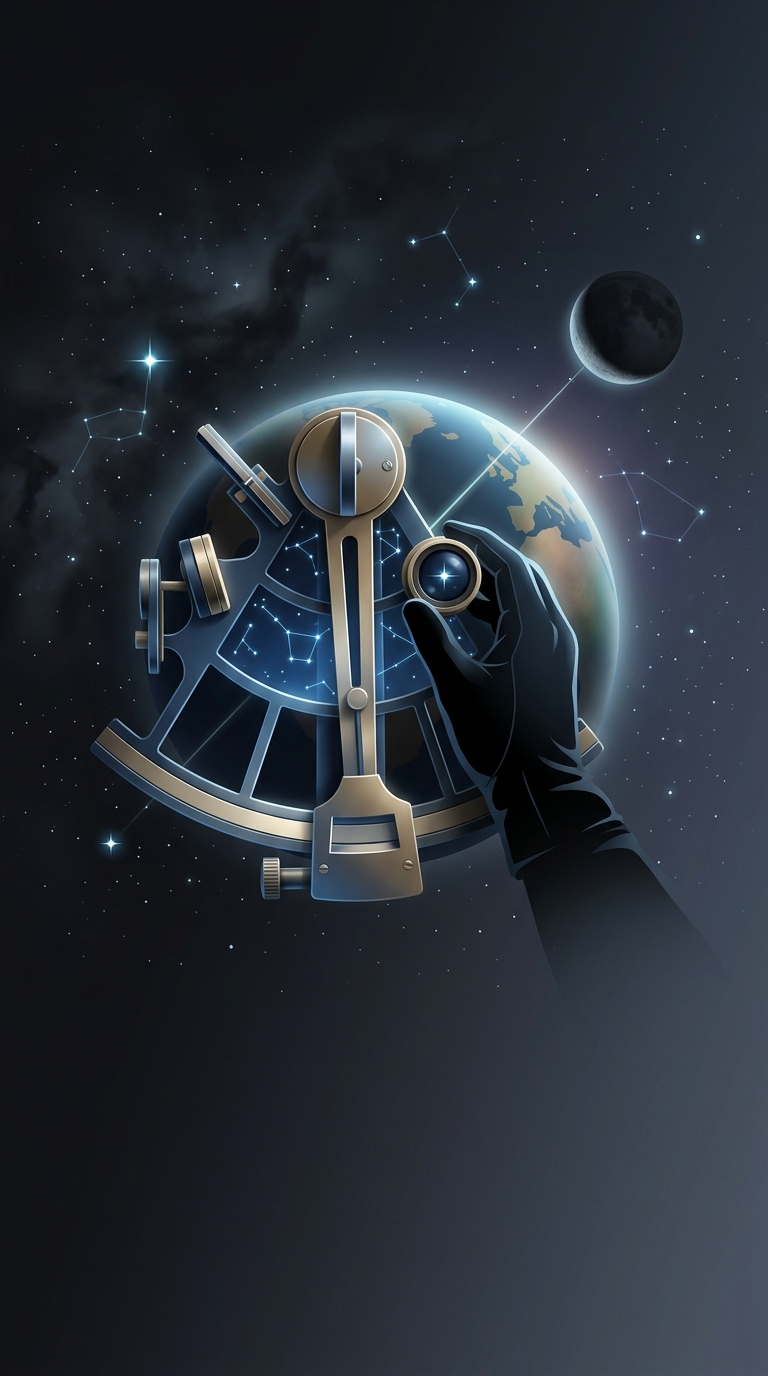
A sextant does not tell you where you are by looking at one star. It measures the angle between two visible targets. In deep space, those targets could be stars, or a star and a recognizable body such as Earth or the Moon. The angle provides a precise geometric clue: from the spacecraft’s known orientation, the onboard guidance computer could use the sighting to refine its estimate of the vehicle’s position.
That distinction mattered because the spacecraft had no road, coastline, or nearby landmark to compare with a map. Stars were so distant that their apparent positions barely shifted as Apollo traveled, making them steady reference points. A planet or the Moon, by contrast, supplied a nearby target whose changing position helped locate the spacecraft along its route.
A Check on the Guidance System
Apollo’s inertial guidance system estimated motion from measurements inside the spacecraft. It tracked acceleration and calculated how far the vehicle had traveled, much like dead reckoning at sea. But small measurement errors can accumulate over time. A star sighting offered an independent check against that growing uncertainty.
The optical instrument made the measurement possible; it did not replace the computer or steer the spacecraft by itself. Astronauts had to identify suitable targets, bring them into the instrument’s view, and take a careful reading. The observation then gave the navigation system information it could compare with its existing estimate.
This was a practical form of redundancy: if one method’s estimate drifted, another could help reveal the discrepancy. On a route where a small navigation error could complicate a later maneuver, a distant star could serve as a fixed reference—and turn empty-looking space into something measurable.