How Roman lead reached Greenland
Roman silver production left a trace thousands of miles from the mines and furnaces. Smelting—heating ore to separate its valuable metal—also released lead into the air. Tiny particles rode winds high into the atmosphere, where some traveled far beyond Europe before settling onto snow in Greenland.
The journey depended on two linked processes: atmospheric transport and steady snowfall. Once lead-bearing particles fell onto the ice sheet, later snow covered them. Over time, the accumulating snow compressed into ice, preserving successive deposits in layers.
Ice layers as a pollution timeline
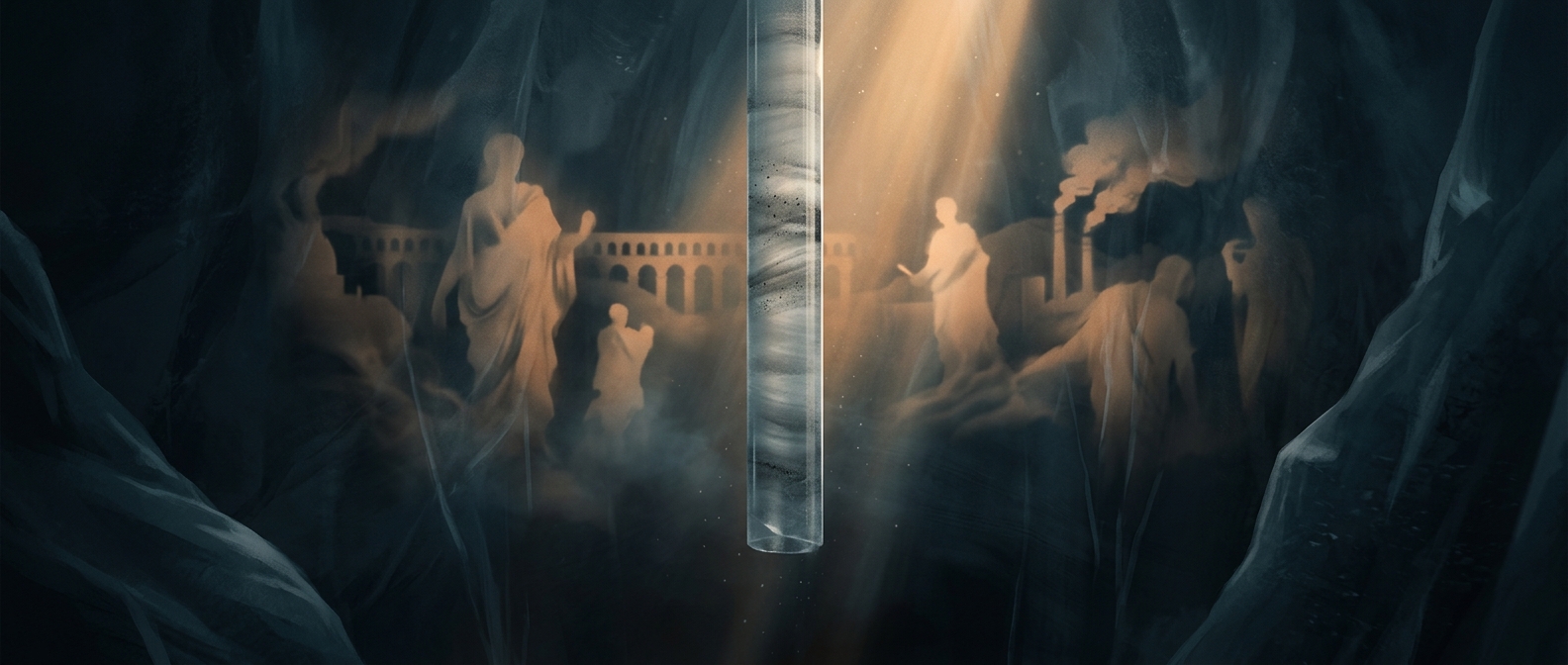
An ice core is a long cylinder drilled from a glacier or ice sheet. Its layers can be dated by counting annual cycles and matching recognizable chemical patterns, much like reading tree rings. Researchers measure lead in samples from different depths; deeper layers generally record older snowfall.
A rise in lead in a dated layer is evidence that more lead was circulating in the atmosphere when that snow fell. Greenland’s remoteness matters: the ice captures pollution carried across oceans, not just emissions from nearby activity. The record can therefore reveal changes in distant industrial emissions that would leave no local written account.
What the record can—and cannot—show
The Greenland ice does not preserve a piece of Roman machinery or identify a particular furnace. Instead, it offers a remote, time-ordered signal of lead pollution. Comparing that signal across layers lets researchers trace when emissions increased or declined and connect those shifts with periods of metal production.
The striking consequence is that an ancient smelter’s exhaust became part of a natural archive: snow falling in Greenland turned airborne pollution into a sequence that can still be examined today.