Why a boundary can carry information about a volume
The holographic idea grew partly from a puzzle about black holes. A black hole’s entropy—a measure of how many microscopic states could produce the same large-scale object—appears to scale with the area of its boundary, not with the volume inside. That is striking because ordinary intuition suggests that a larger volume should hold proportionally more information.
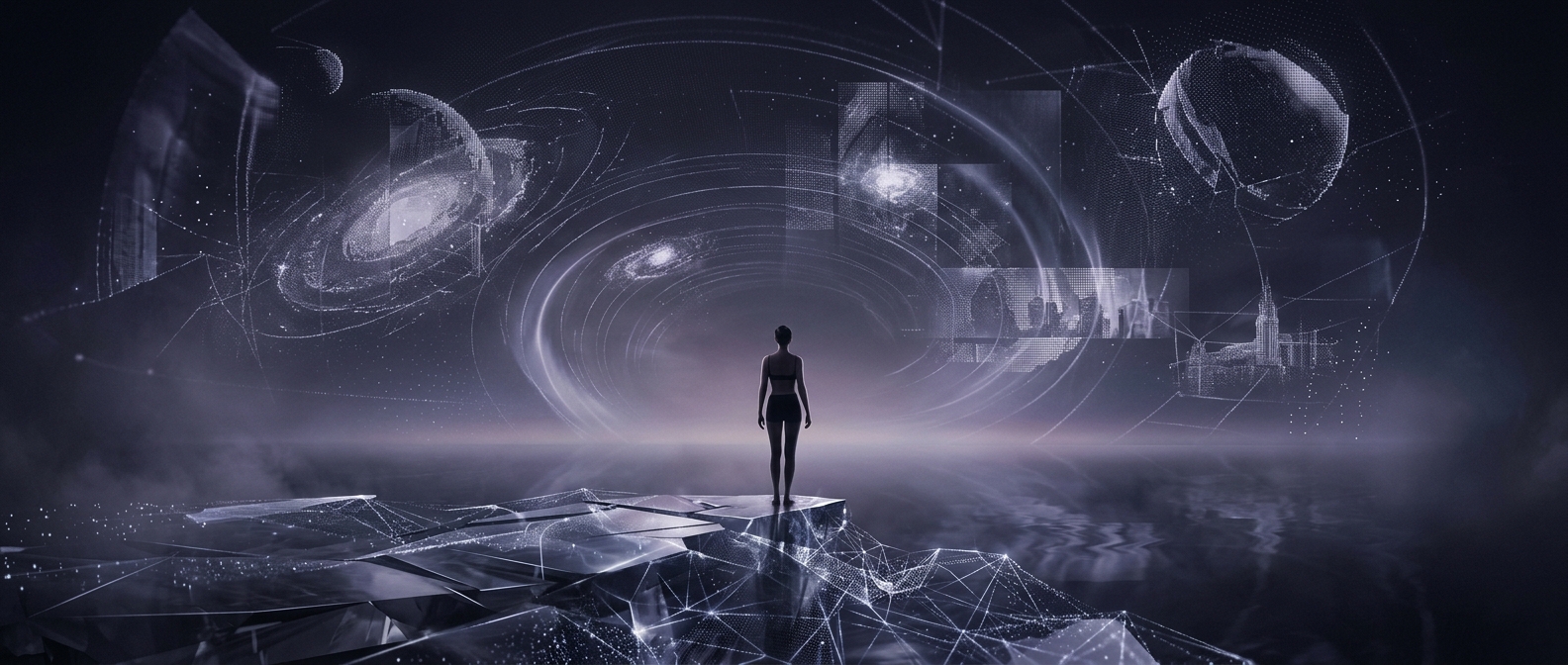
This area-based clue led physicists to ask whether a description of a region with gravity might be equivalent to a different description that lives on a lower-dimensional boundary. In some mathematical models, the two descriptions can represent the same physics: calculations in the boundary theory can correspond to events in the higher-dimensional interior. The boundary is not a screen displaying a picture; it is another way to encode the system.
What “hologram” does—and does not—mean
A well-known example is a theoretical correspondence in which a universe with gravity in its interior is related to a boundary theory without gravity. It gives researchers a powerful way to study problems that are difficult in one description by translating them into the other. But this result applies to particular mathematical settings; it does not establish that our universe is literally built from a visible surface or that every feature of our cosmos has been shown to obey the same correspondence.
Nor does holographic encoding settle whether the universe is infinite. The number of dimensions in a description and the overall size of the universe are different questions. A model can relate a volume to a boundary without saying that the volume is finite, that the boundary is a physical edge, or that space ends somewhere. “Boundary” here is part of the mathematical setup, not necessarily a place an observer could reach.
The striking implication is subtler than a cosmic projection: in the right theory, the same physical information may be organized in two very different ways. That possibility lets physicists investigate whether gravity and spacetime could emerge from relationships described in a more fundamental language.