A royal landscape mapped onto the night sky
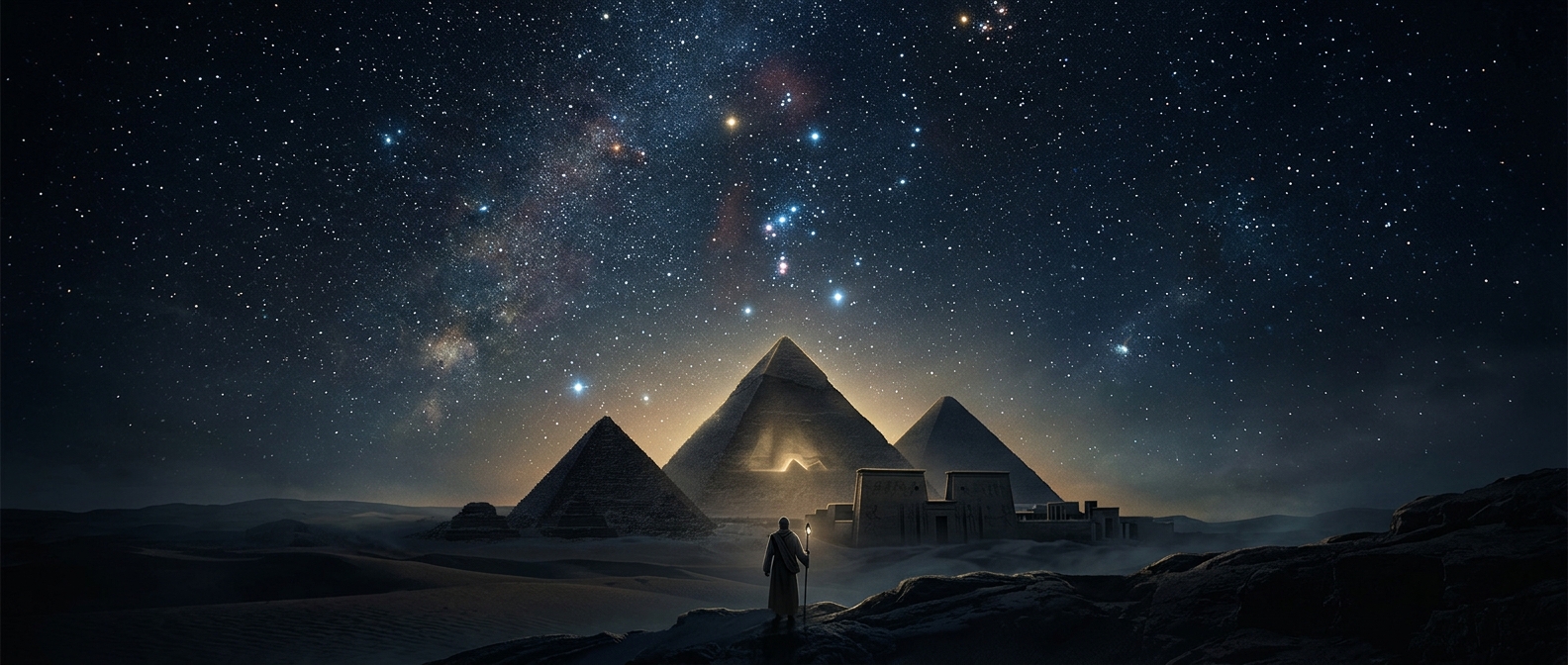
One proposed explanation for the arrangement of the Giza pyramids is that it echoes Orion’s Belt: the three conspicuous stars that form a short, uneven line in the constellation Orion. Seen from the ground, the pyramids likewise form a row, with their relative positions sometimes compared to the stars’ spacing. The idea is not that the builders copied a star chart onto the desert, but that the monuments’ placement may have carried a celestial reference.
That comparison would have depended on naked-eye astronomy. Without telescopes, ancient observers could still recognize recurring star patterns and follow their movements across the seasons. A familiar constellation could serve as a stable point of reference in a landscape where the horizon and the night sky were both part of everyday experience.
Why the stars mattered to a tomb
For ancient Egyptians, a royal tomb was more than a place to preserve a body. Burial and kingship were bound up with ideas about the ruler’s passage into the afterlife, and the sky offered a powerful setting for those ideas. Orion was associated in Egyptian tradition with Sah, a celestial figure connected with Osiris, the god of the dead and renewal. Linking a royal monument to the heavens could therefore make its meaning both physical and religious: the tomb stood on earth while pointing toward a cosmic order.
The proposed alignment is best understood as an interpretation of the pyramids’ pattern, not proof that every feature was designed as a precise star map. Its enduring appeal lies in the possibility that the Giza skyline was meant to be read in two directions at once—from the desert toward the stars, and from the stars back to the resting place of a king.