The gravity dispute was about more than one idea
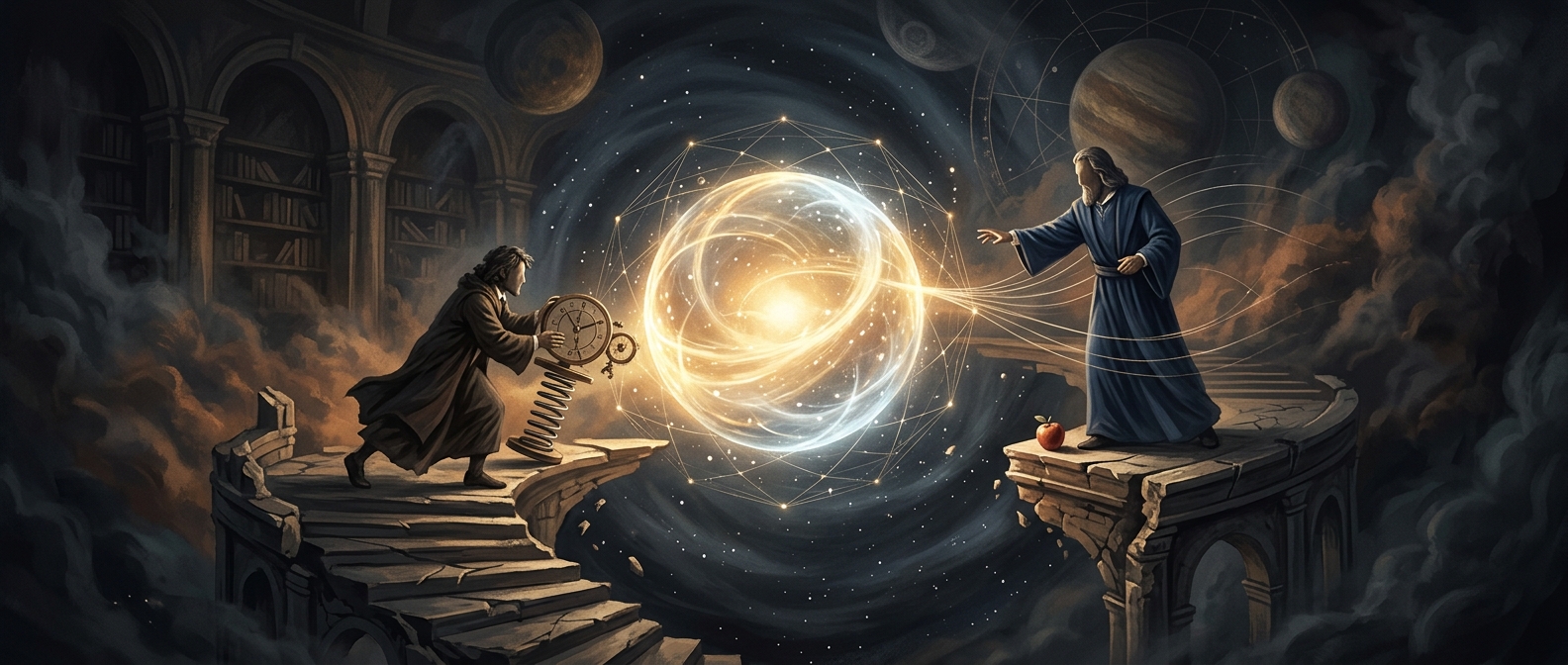
Robert Hooke and Isaac Newton clashed over who deserved credit for explaining how gravity governs planetary motion. Hooke argued that he had proposed a key principle: planets move forward by inertia while being continually drawn toward the Sun, with the attraction weakening as distance increases. He also maintained that gravity followed an inverse-square rule—twice as far away, one-quarter the pull.
That was an important conceptual claim, but it was not the whole mathematical solution. Newton showed how such a force could produce the paths of planets and developed the argument into a broad system of mechanics. His Principia, published in 1687, made that system famous.
A difficult line between suggestion and proof
The disagreement turned on what counted as a scientific contribution. Hooke said he had supplied the central insight and that Newton had built on it without giving him sufficient credit. Newton resisted the claim that Hooke had established the result: proposing a force that weakens with distance is different from demonstrating mathematically that it explains orbital motion.
Hooke’s letters and conversations did matter to Newton’s work, but the surviving record does not make the dispute a simple case of one man inventing gravity and another stealing it. Newton had pursued mechanics independently, while Hooke’s correspondence helped frame questions about planetary motion. Their conflict was about the boundary between a powerful suggestion and a complete demonstration—as well as who should be named when the explanation was published.
Why Newton’s version endured
Newton’s mathematical framework proved exceptionally influential, and his stature gave his account lasting reach. Hooke’s contributions were harder to separate from the quarrel and from the difference between proposing a principle and deriving its consequences. The result was an uneven legacy: Newton became the defining name associated with universal gravitation, while Hooke’s role was easier to overlook.
The feud matters because scientific memory is not just a record of who had an idea first. It also reflects whose work was developed, published, and carried forward—and how bitter disputes can shape the credit later generations inherit.