A cloud of balloons has to read as one force
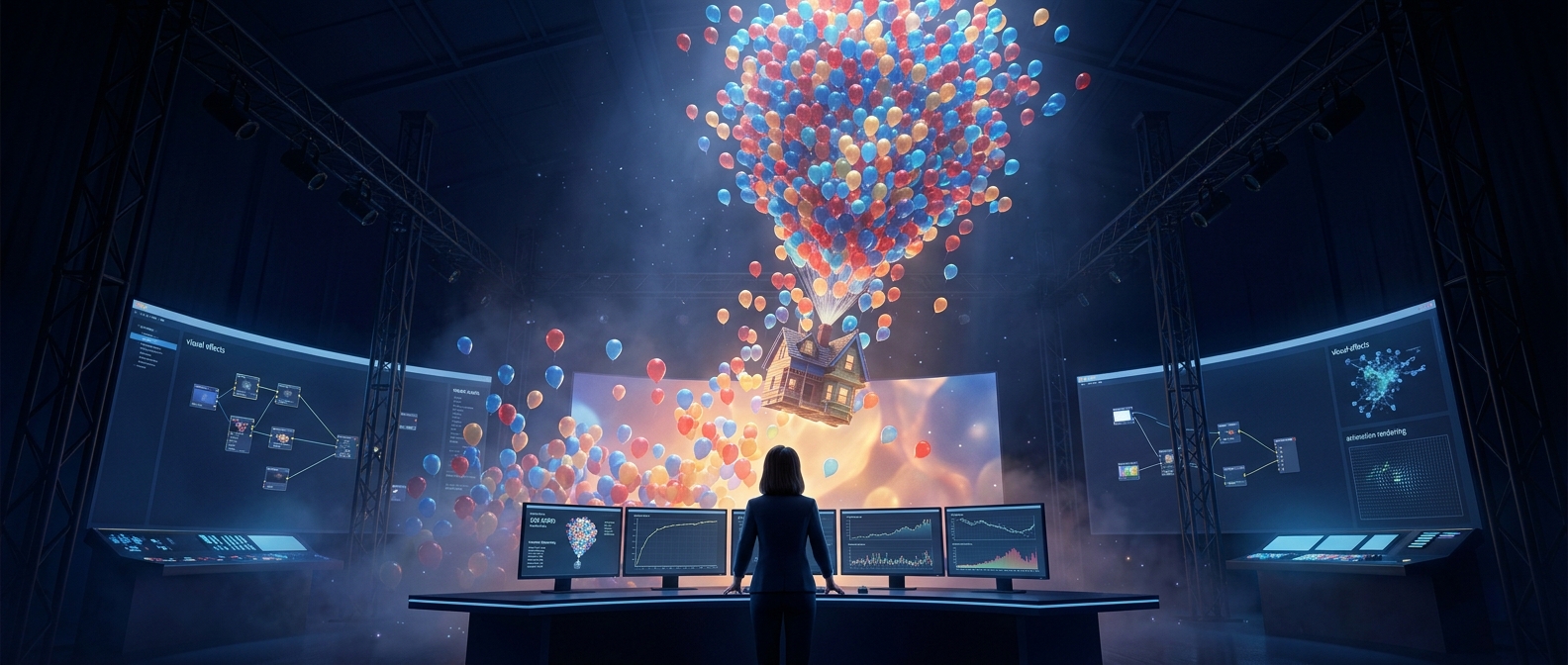
A few balloons tied to a house suggest decoration; thousands gathered above it suggest lift. In Up, the 20,622 rendered balloons make the house’s upward motion legible at a glance: the eye sees a dense canopy pulling against the weight of the building below.
The count matters because balloons are individual shapes, not a single colored cloud. Each one adds a rounded outline and a patch of color. Packed together, they form a mass; spaced too far apart, they would look sparse and make the house seem less supported. Their overlapping forms also give the canopy depth, so it feels like a volume of objects rather than a flat backdrop.
Convincing lift is a visual effect
The number is not an engineering calculation of how many real balloons would raise a house. It is part of the image-making problem: the scene must make an impossible premise feel readable and coherent. The balloons need to look numerous enough to overwhelm the house’s visual weight, while remaining distinct enough that viewers can recognize what is carrying it.
Rendering each balloon separately gives the artists control over that balance. The result is a memorable contrast: a small house beneath a vast, intricate cluster, with thousands of simple shapes working together to make the impossible flight feel clear on screen.