How a gramophone made a needle audible
A record groove is a tiny moving track. As the disc turns, its walls guide the stylus—the needle—through rapid side-to-side or up-and-down motion. The stylus passes that motion into a thin diaphragm in the soundbox, which vibrates and sets nearby air moving.
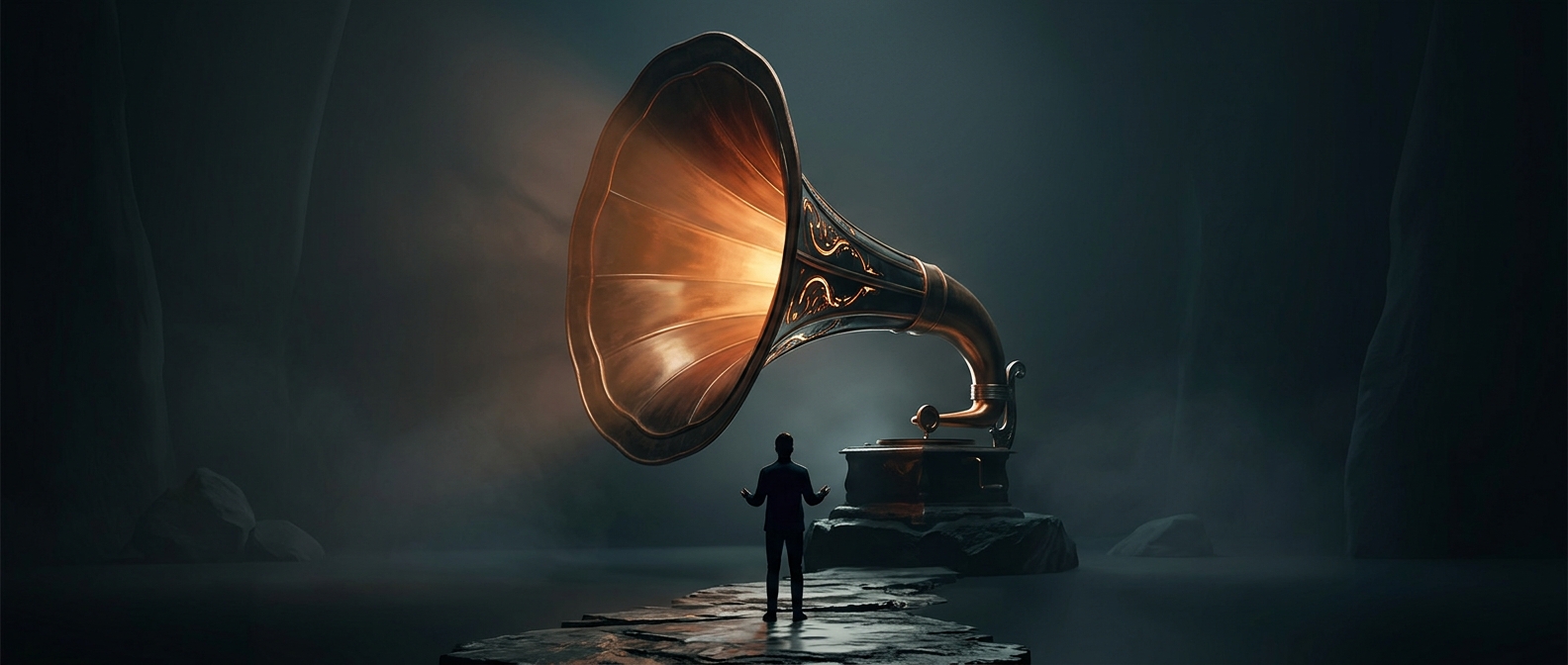
The diaphragm alone displaces too little air to make much sound across a room. A horn helps bridge that gap. Its narrow end sits beside the diaphragm; as the horn widens, it couples the diaphragm’s small movements to a larger volume of air, directing the resulting sound outward. The horn does not create extra energy: the record’s mechanical motion still supplies it. The horn makes that motion more effective at reaching listeners.
The tradeoff behind the size
A broad, flared horn could make playback louder and more projecting, but it had to be physically large to work well. Its shape also colored the sound: some pitches carried more strongly than others, and the needle, diaphragm, and horn could not reproduce every detail of a modern recording. The result was shaped as much by the soundbox and horn as by the groove itself.
That visible funnel was therefore not merely decoration. It was the gramophone’s acoustic machinery—a way to turn faint vibrations into room-filling sound without a microphone, amplifier, or loudspeaker. Move the needle across the record, and the whole chain worked mechanically, from groove to diaphragm to horn to air.