Why Early Loudspeakers Favored Reach Over Refinement
A public-address loudspeaker had a different job from a home hi-fi speaker: it needed to make speech audible across a noisy, open space. Outdoors, sound spreads into a much larger area than it does in a room, while crowds, wind, and distance make quiet details easy to lose. Designers therefore prioritized acoustic output—how much sound the system could deliver—over faithful reproduction of every note.
Turning an Electrical Signal Into Crowd-Filling Sound
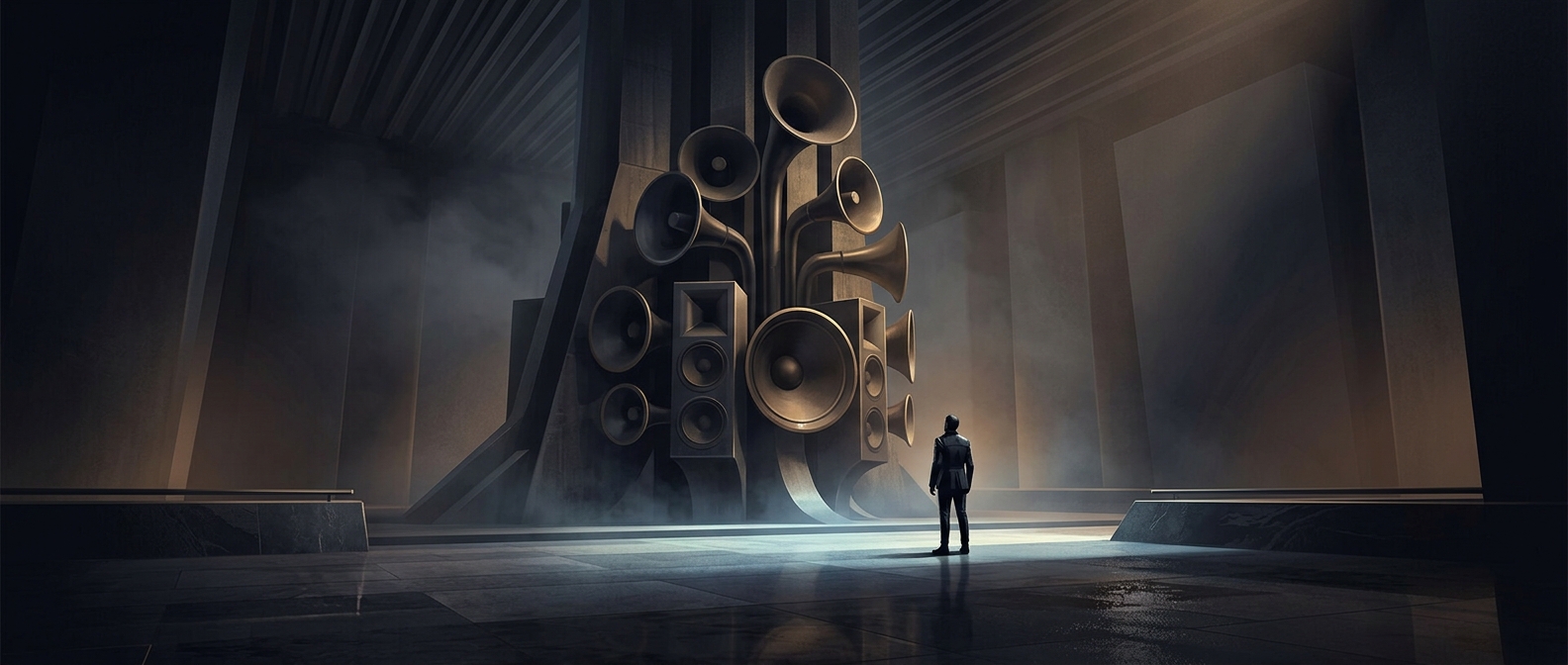
In an early dynamic loudspeaker, an electrical audio signal passes through a coil of wire placed in a magnetic field. The changing current makes the coil move; attached to a cone or diaphragm, it pushes and pulls the surrounding air, producing sound waves. To address a crowd, the system had to move enough air, and its horn or other projecting structure helped direct that sound toward listeners rather than letting it disperse in every direction.
That design favors strong, intelligible speech. The frequencies that carry much of the clarity of spoken words can be projected effectively without reproducing the full range and subtle balance expected in music. A violin recording, by contrast, exposes missing harmonics, uneven tones, and distortion that might barely matter when the goal is simply to understand an announcement.
A Different Standard of “Good” Sound
The tradeoff was practical, not accidental: a public-address system was judged by whether people at the back could hear the message. That emphasis helped make amplified announcements useful in large outdoor gatherings, where an unamplified human voice could not reliably reach everyone. The same loudspeaker could reproduce music, but its success was measured less by the delicacy of a concerto than by whether a short spoken instruction carried through the crowd.