Why the matching orbit works
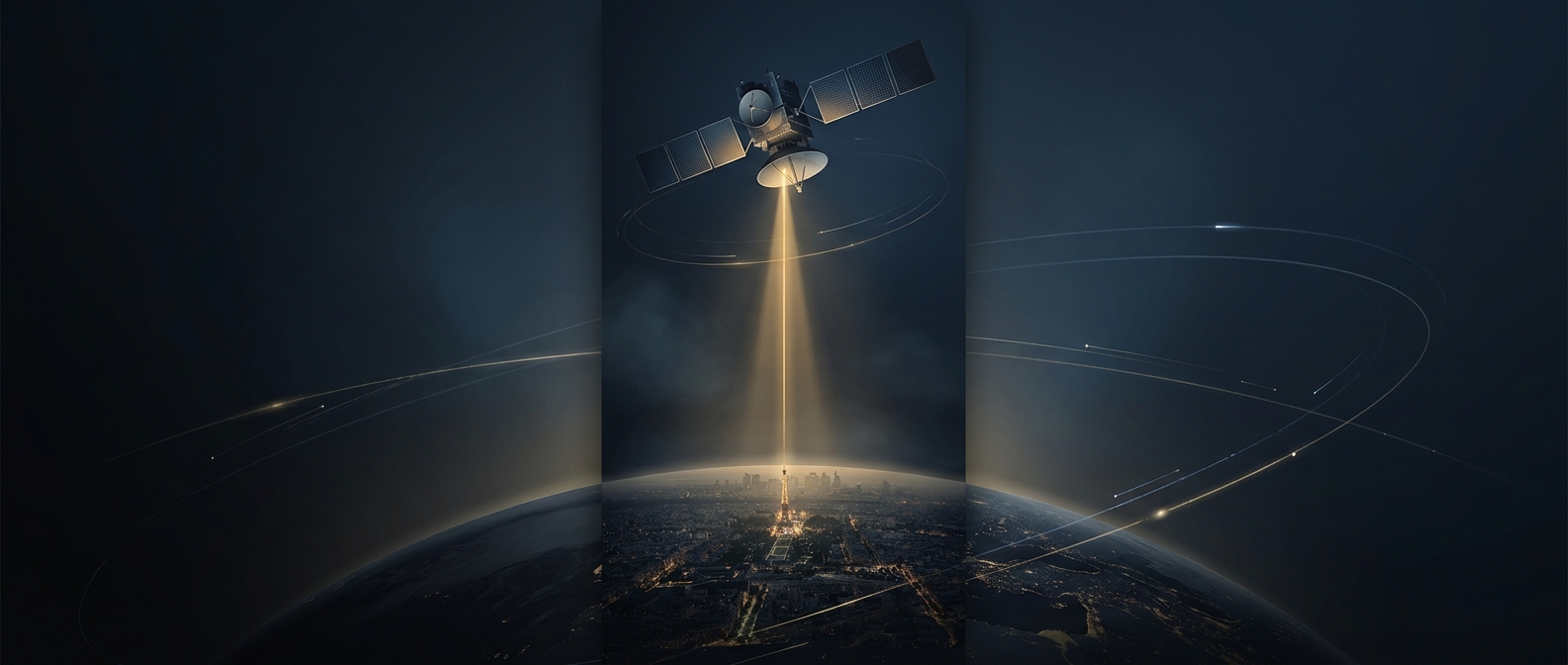
A geostationary satellite is not holding itself in place. It is falling around Earth continuously: gravity pulls it inward, while its sideways speed carries it forward so that it keeps missing the ground. The farther an object orbits from Earth, the longer it takes to complete a lap. At about 35,786 kilometers above the equator, the orbital period matches Earth’s rotation relative to the stars—just under 24 hours.
That match alone is not enough. The satellite must travel eastward in a nearly circular orbit directly above the equator. If its path tilted north and south, or stretched into an oval, it would appear to drift across the sky during the day. In a properly aligned orbit, it keeps pace with the ground beneath it.
The practical payoff—and the limits
Because the satellite stays in the same direction, a ground station can point a fixed dish at it instead of tracking a moving target. That makes the orbit useful for television and radio broadcasts, weather monitoring, and communications links that need continuous coverage of the same broad region.
The geometry has a cost. A satellite over the equator cannot look straight down on the poles, and Earth’s curvature leaves some high-latitude areas low on the horizon or out of view. The great distance also means signals take a noticeable time to travel between Earth and the satellite. So the orbit trades broad, steady coverage for distance and limited reach: the same sky position that simplifies a dish’s job also shapes who can use the satellite and how quickly it can respond.