Why Hyperion’s spin won’t settle down
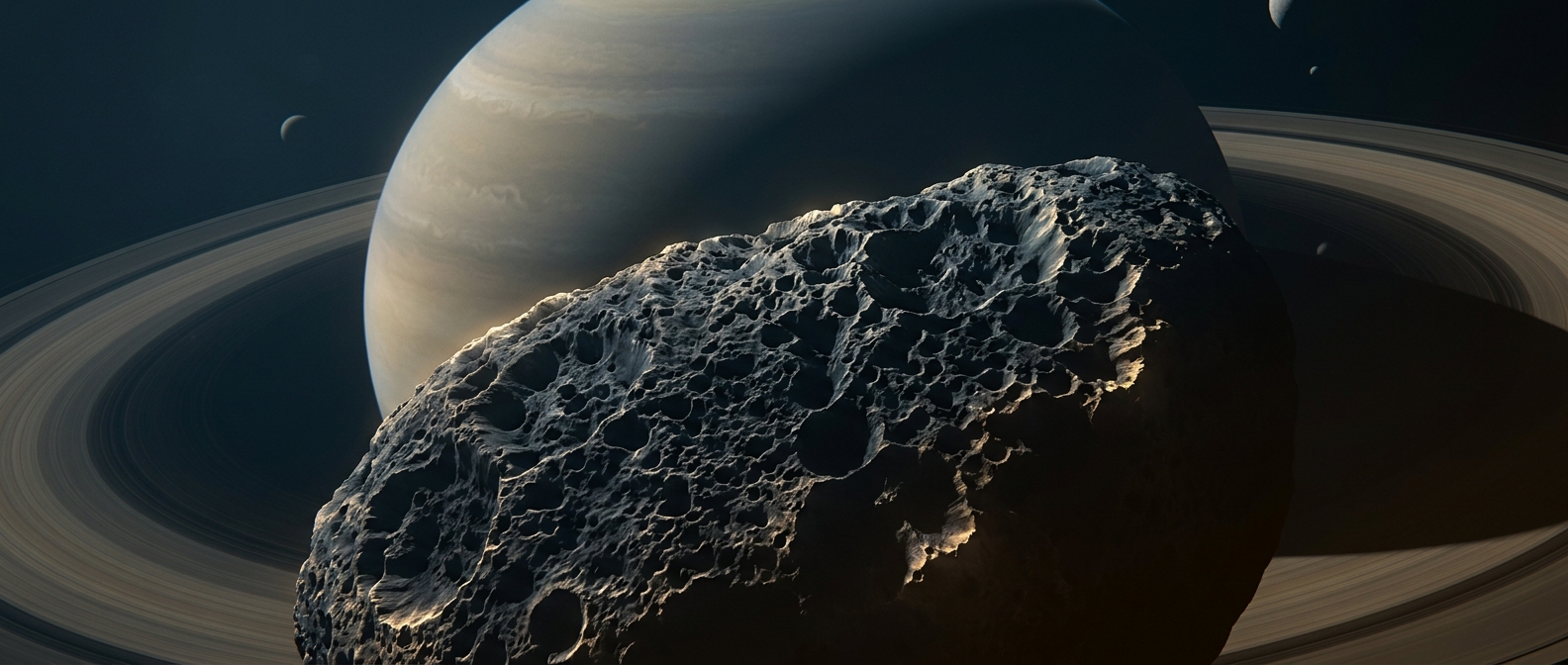
Hyperion’s sponge-like appearance comes from a surface crowded with deep craters, but its unusual rotation has a different cause: the moon is far from a balanced sphere. Its lumpy shape means its mass is unevenly distributed, so Saturn’s gravity pulls more strongly on some parts than others. That uneven pull creates a turning force, or torque.
For a nearly spherical moon, gravity has little leverage to twist it, and its rotation can remain steady. Hyperion’s irregular shape gives Saturn more leverage—and its changing distance and position during its orbit make the pull vary over time.
Titan keeps the motion unsettled
Saturn’s large moon Titan also tugs on Hyperion. As the two moons move around Saturn, Titan’s gravitational influence changes, adding another shifting torque. The result is not a simple wobble around one fixed axis: Hyperion’s orientation and spin rate can change in a complicated, hard-to-predict way. This kind of motion is called chaotic rotation. “Chaotic” does not mean the moon spins without physical causes; it means small differences in its motion can grow into large differences in how it is oriented later.
That makes Hyperion a striking contrast to a clocklike moon that keeps the same face pointed toward its planet. Its battered shape and the competing, changing pulls from Saturn and Titan continually rearrange how it turns—so its next orientation is unusually difficult to forecast.