How Jupiter reshapes a comet’s route
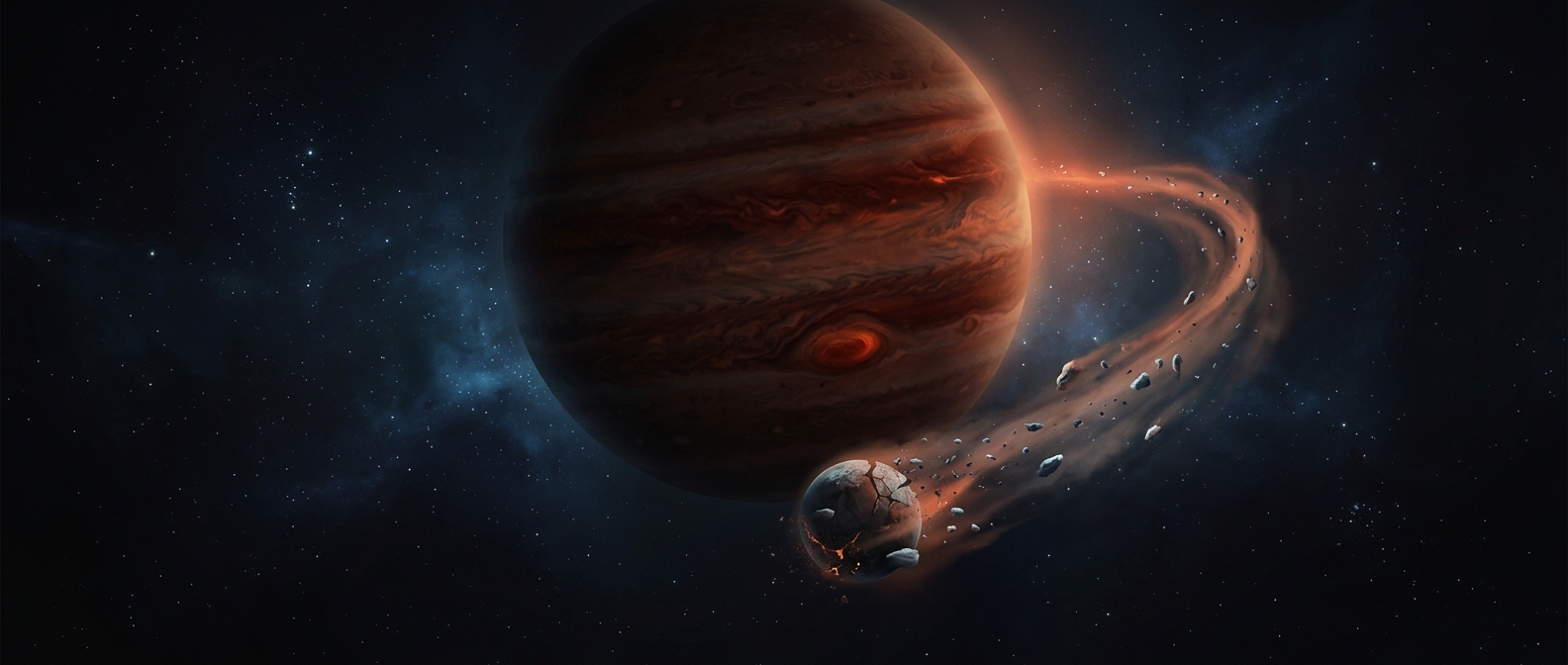
A comet does not need to collide with Jupiter for the planet to change its orbit. As the comet approaches, Jupiter’s gravity bends its path. The result depends on where Jupiter is in its own orbit and how the two bodies pass one another: the comet can leave on a route that brings it closer to the Sun, sends it farther out, or removes it from the solar system altogether.
The key is that Jupiter is moving. In a simple encounter with a stationary object, gravity would change a comet’s direction but not its speed afterward. Because Jupiter itself orbits the Sun, a close pass can also transfer a little orbital energy between planet and comet. The change is tiny for Jupiter, whose mass is enormous, but it can substantially alter the much smaller comet’s future path.
Why the effect is not a one-way shield
Whether that redirection protects Earth depends on the comet’s starting orbit and the details of the encounter. Jupiter can eject some objects that might otherwise travel through the inner solar system. It can also steer others inward, where they may cross the paths of Earth and the other rocky planets. Over time, repeated encounters can transform an object’s orbit rather than simply clear it away.
Astronomers therefore do not treat Jupiter as a reliable cosmic guard. Its influence helps determine which small bodies reach the inner solar system, but it can both reduce and increase the supply. The planet’s role is less like a broom than a powerful orbital switchyard: one close pass can decide whether a comet becomes a distant wanderer, an incoming visitor, or an object lost to interstellar space.