Why Jupiter’s moon count is crowded with small bodies
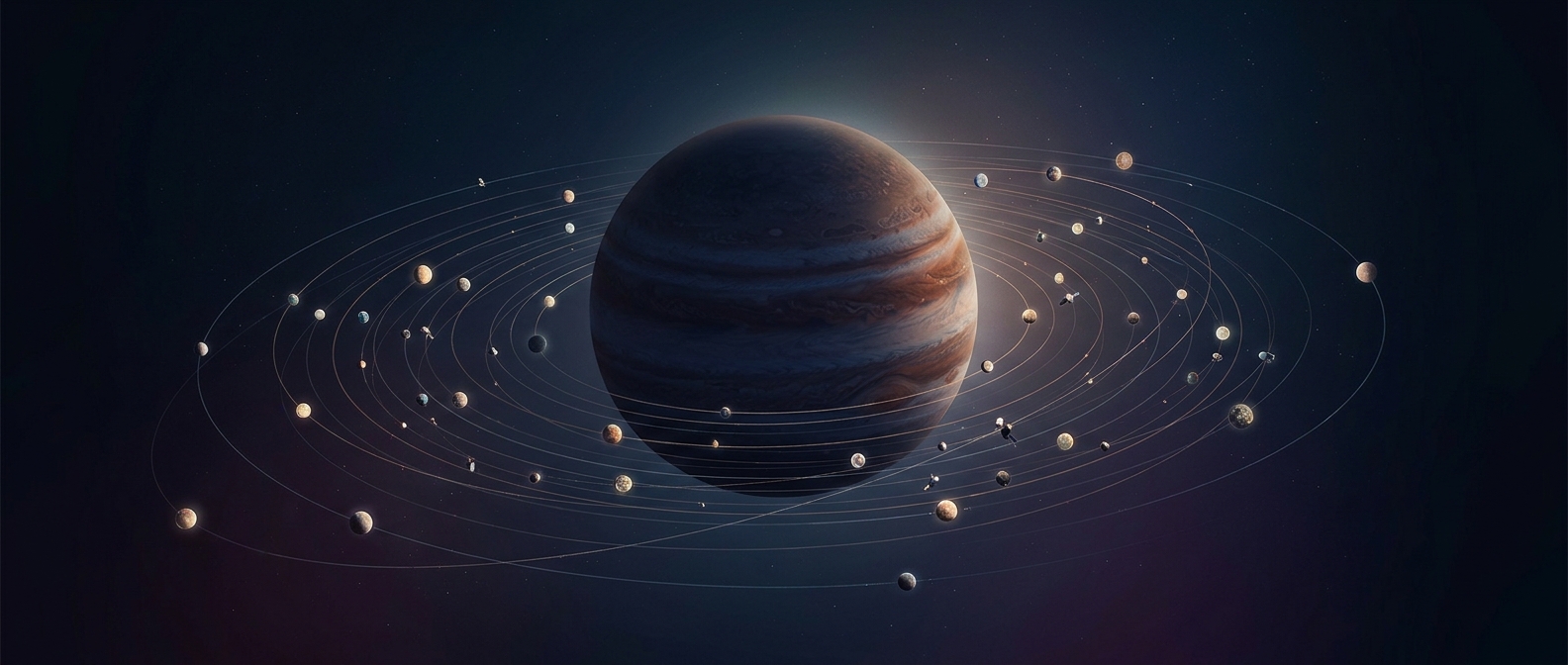
Jupiter’s many small moons are not simply miniature versions of Ganymede. Most are irregular satellites: bodies that travel far from the planet on tilted, stretched, or even backward-moving orbits. Those paths differ from the nearly circular, orderly orbits of the large inner moons, which formed in a disk of material around young Jupiter.
The distinction points to different origins. A small object passing Jupiter cannot become a permanent moon merely by being pulled by gravity; it must lose energy. Early in the solar system, interactions with other bodies—or drag from surrounding gas—could slow passing objects enough for Jupiter to retain them. Some captures may instead have involved a passing object breaking into a pair, allowing one piece to be captured while the other carried away energy.
One capture can become a cluster
After capture, a moon could be shattered by a collision. The fragments remain on broadly similar orbits, creating families of related small moons. That is why Jupiter’s outer satellites are not necessarily a collection of unrelated, intact worlds: some are likely remnants of larger objects broken apart over time.
Their small size also helps explain why the inventory keeps growing. A distant, dark, irregular body is harder to spot than a large moon near Jupiter, and it can take repeated observations to confirm that a faint point of light is actually orbiting the planet. Better surveys can therefore add members to the catalog without revealing new worlds on Ganymede’s scale.
The result is a moon system with two very different populations: a few prominent bodies that formed close to Jupiter, and a wider outer swarm shaped by capture and collision. Jupiter’s count is impressive partly because its gravity has gathered—and its history has broken up—so many small travelers.