How Saturn’s Huge Volume Outweighs Its Huge Mass
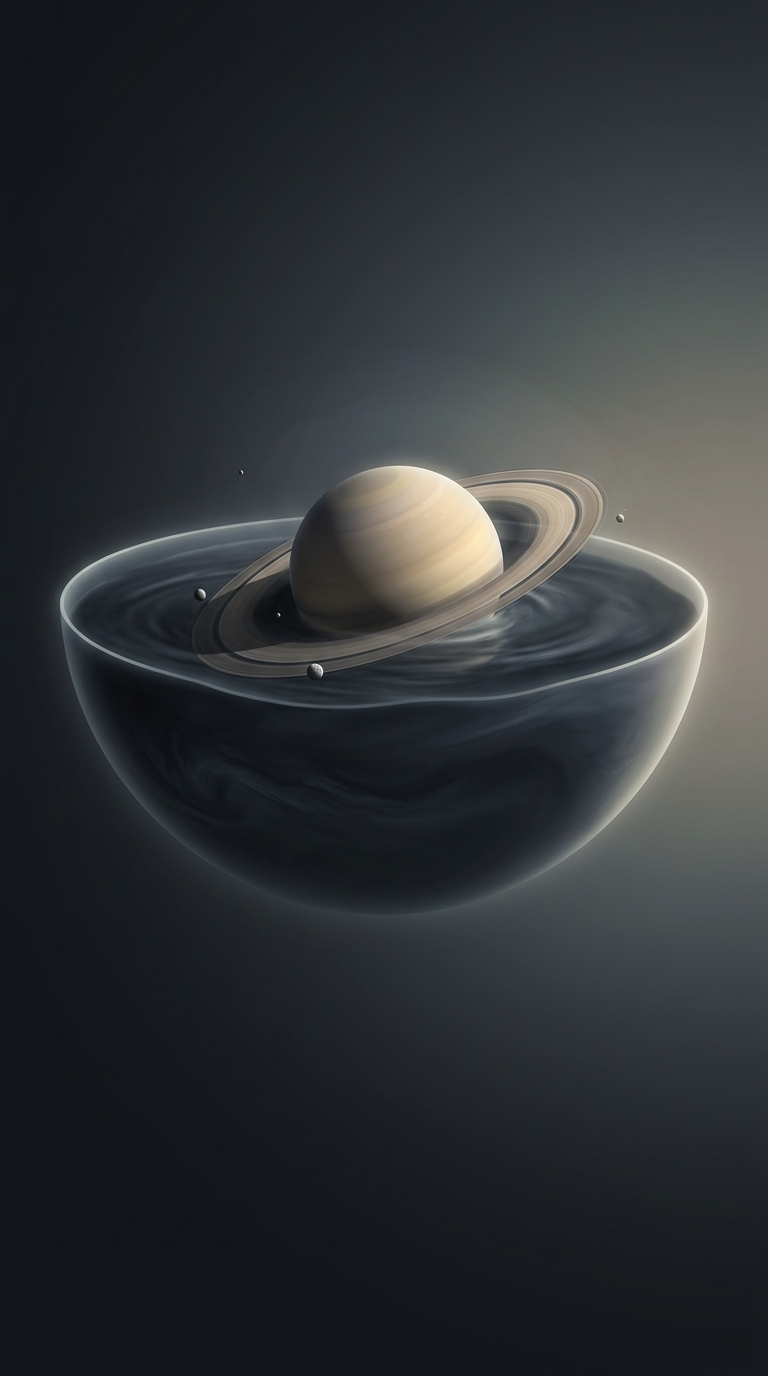
Density is mass divided by volume. Saturn contains far more material than Earth, but it also occupies an enormous amount of space. Averaged across the whole planet, its density is about 0.69 grams per cubic centimeter—below water’s roughly 1 gram per cubic centimeter.
That average does not mean Saturn is a loose cloud of ordinary gas. The planet’s outer layers are mostly hydrogen and helium, while pressure rises sharply toward the center. Deeper inside, hydrogen is squeezed into a dense, electrically conducting form called metallic hydrogen. The average combines these very different regions, including the planet’s vast, comparatively light outer layers.
Why a Gas Giant Has No Floating Surface
On Earth, an object floats when the water it displaces weighs more than the object itself. That familiar rule helps explain the comparison, but Saturn is not a solid object with a boundary that could rest on water. Its visible cloud tops mark an atmospheric layer, not a hard shell; gas becomes denser and hotter as it descends into the planet.
A real ocean large enough to surround Saturn would also be reshaped by the planet’s gravity. Water would not remain a calm, flat bath beneath a planet-sized object. So the bathtub image is useful for comparing average density, not for imagining a physically workable floating planet. The surprising point is that Saturn can be both immense and, on average, lighter per unit volume than water because its bulk is dominated by a huge envelope of hydrogen and helium.