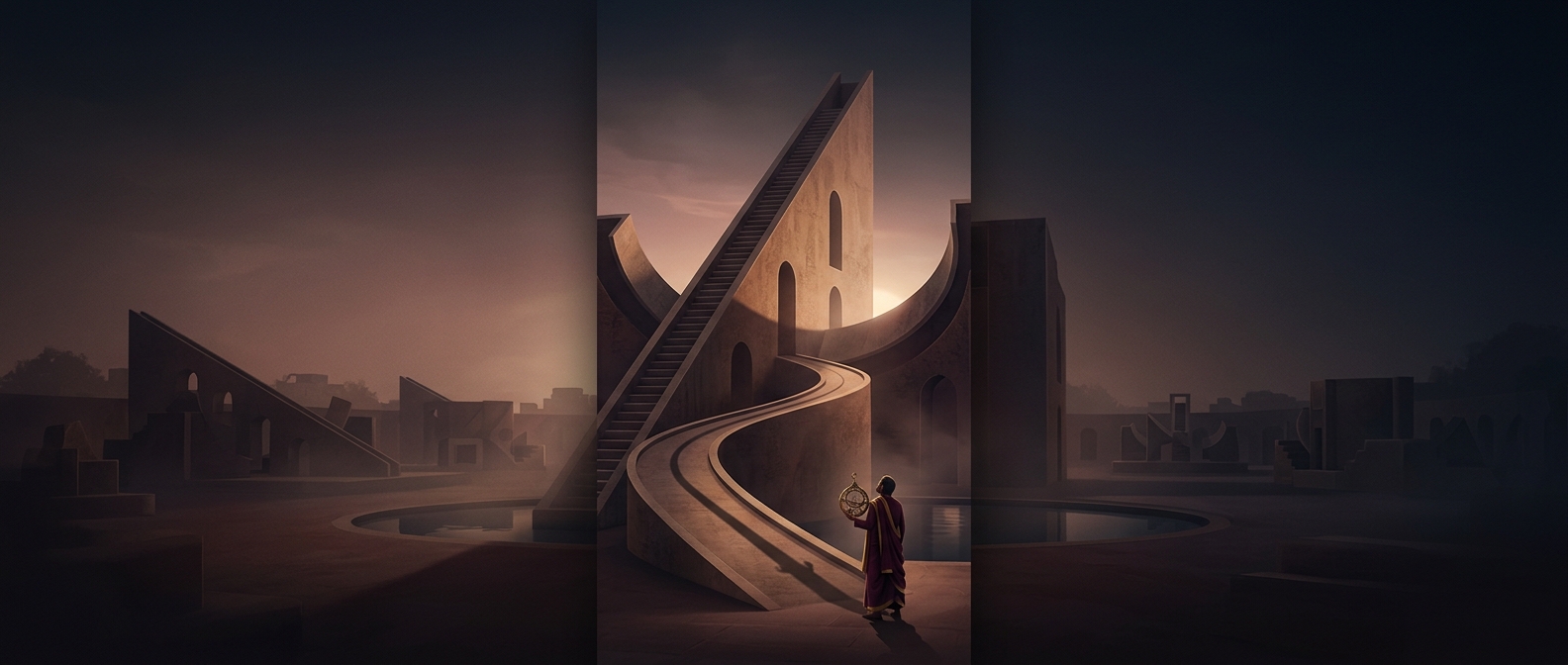
A stone instrument aligned with the sky
At Jaipur’s Jantar Mantar, the great sundial is the Samrat Yantra, an instrument built in the 18th century under the patronage of Maharaja Sawai Jai Singh II. Its central triangular wall is not simply a tall pointer: it is set parallel to Earth’s rotational axis. As Earth turns, the Sun appears to travel across the sky, and the wall’s shadow moves across graduated stone surfaces on either side.
Those curved surfaces are marked so observers can read the shadow’s position as local solar time. The instrument turns the sky’s motion into a measurement: instead of watching a small hand on a dial, an observer reads a changing boundary of light across architecture.
Why build it so large?
A sundial’s reading depends on seeing exactly where its shadow falls. A larger instrument spreads small changes in the Sun’s apparent position across a greater distance, making them easier to distinguish. The massive masonry also provides a fixed structure for the carefully aligned surfaces and their markings.
The observatory’s instruments were designed for direct observation of celestial movements, not merely as monuments. Their measurements could help track time and the positions of heavenly bodies, information useful for making calendars and organizing astronomical observations. The Samrat Yantra’s scale makes the method unusually legible: the passage of time becomes a shadow moving across stone.