Why a Sled Needed Tracks to Cross Deep Snow
A horse pulling a conventional sled could make progress on a packed trail, but loose, unplowed snow was a different problem: the runners could sink, and there might be no firm path to follow. Early inventors including Elon J. Farnsworth experimented with replacing that narrow contact with a continuous track—a moving belt that spreads the vehicle’s weight over a longer patch of ground.
As the belt circulates, its broad surface presses against the snow and pushes backward. The snow’s resistance pushes the sled forward. Spreading the load also reduces the pressure at any one point, helping the vehicle stay atop soft snow instead of digging in as deeply as narrow runners or wheels might.
From Pulling Sled to Powered Vehicle
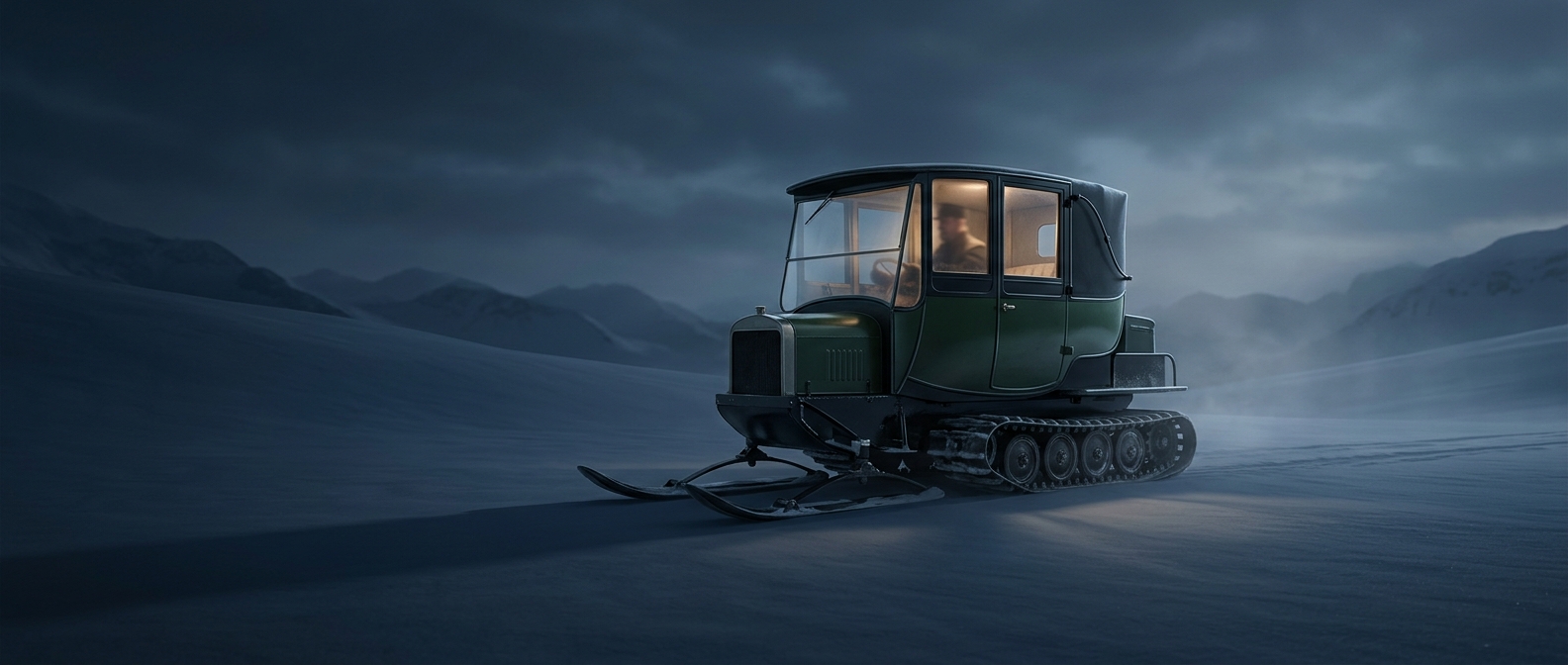
A track alone does not make a practical snow machine. It needs a power source to turn the belt, a way to steer, and a frame that can carry the machinery without becoming too heavy. Early track-equipped sleds were experiments in solving those linked problems: how to move across snow under their own power rather than depend on a horse or a prepared route.
That basic arrangement—an engine driving a track, with a steerable front end—became central to the snowmobile. The important shift was not simply adding a motor to a sled. It was designing a vehicle whose contact with the ground could provide both flotation and forward grip. On unplowed snow, that broad, moving belt is what lets a compact machine travel where a runner-bound sled would struggle.