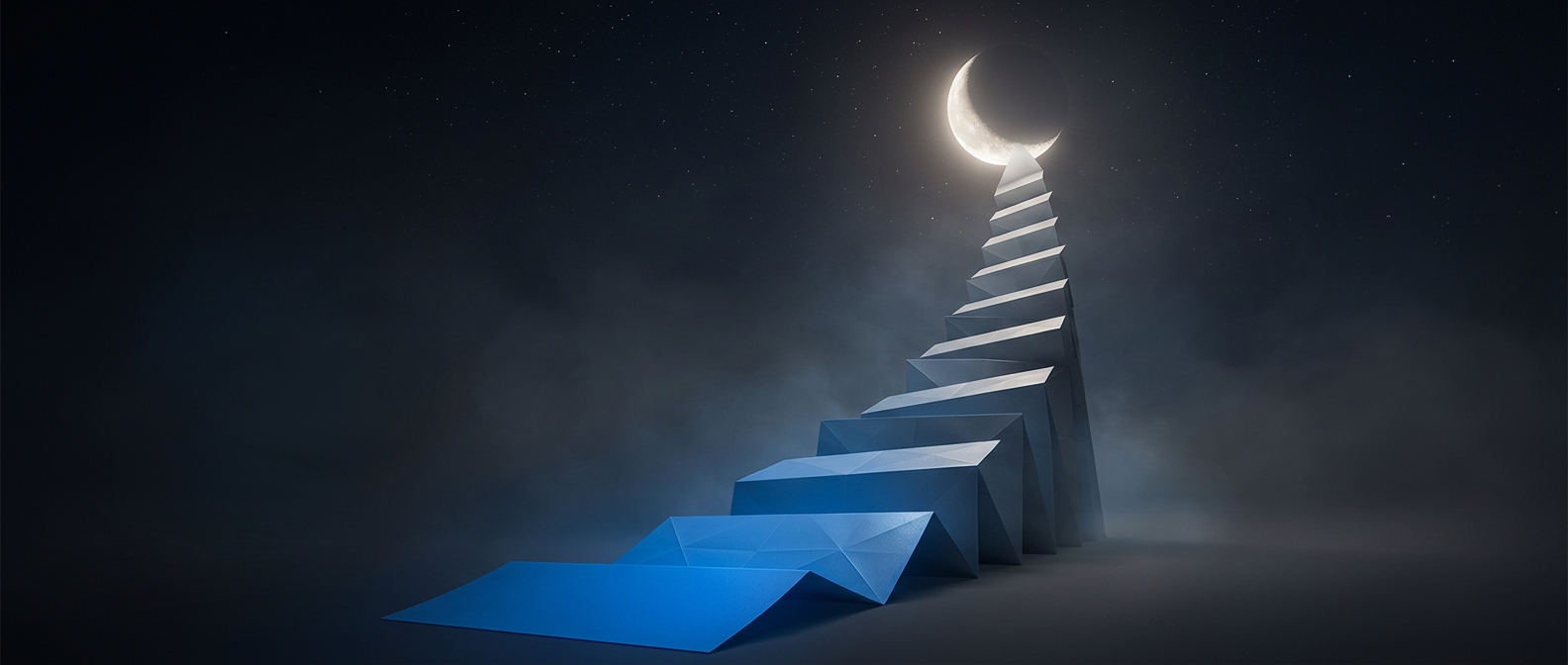
Why 42 folds become a lunar-scale number
A fold does not add one paper-thickness to the stack; it doubles the number of layers. If a sheet begins about a tenth of a millimeter thick, then after n ideal folds its thickness is roughly that starting thickness multiplied by 2ⁿ. The early folds add little, but the later ones multiply an already large stack: 42 doublings produce about 4.4 trillion layers.
At that starting thickness, the calculated stack would be roughly 440,000 kilometers thick—greater than the Moon’s average distance from Earth, about 384,000 kilometers. The comparison is a mathematical extrapolation, not a practical folding demonstration: it assumes every fold works cleanly and the layers compress into a simple stack.
Why real paper stops far sooner
Each fold has to bend the entire growing stack, not just a single sheet. The thicker the stack becomes, the more paper must curve around the fold, and the more force is needed to bend and press it. The sheet also has to be large enough to wrap around that increasing bulk. Those demands rise quickly, while ordinary paper tears, crumples, or resists the bend.
That is why the Moon result is memorable: it reveals how doubling can outrun ordinary intuition. A stack that grows by a fixed amount would remain modest; one that doubles can leap from barely noticeable to astronomical in just a few dozen steps.