A dungeon escape built around a spatial trick
In Narbacular Drop, portals were not just doors between rooms. They let players make two distant surfaces act like connected openings: step into one, and emerge from the other. That turned the dungeon itself into a puzzle tool. A wall that seemed to block progress could become an exit if the player found the right place to open a portal.
The key design challenge was making this power understandable and useful. If portals could be placed anywhere without limits, they might erase the need to solve a level. Instead, the game’s puzzles depended on reading the room—spotting reachable surfaces, tracing a route through them, and recognizing how one opening changed the meaning of the space. The player was not simply looking for a key; they were learning to think in connected viewpoints.
From student experiment to a larger game
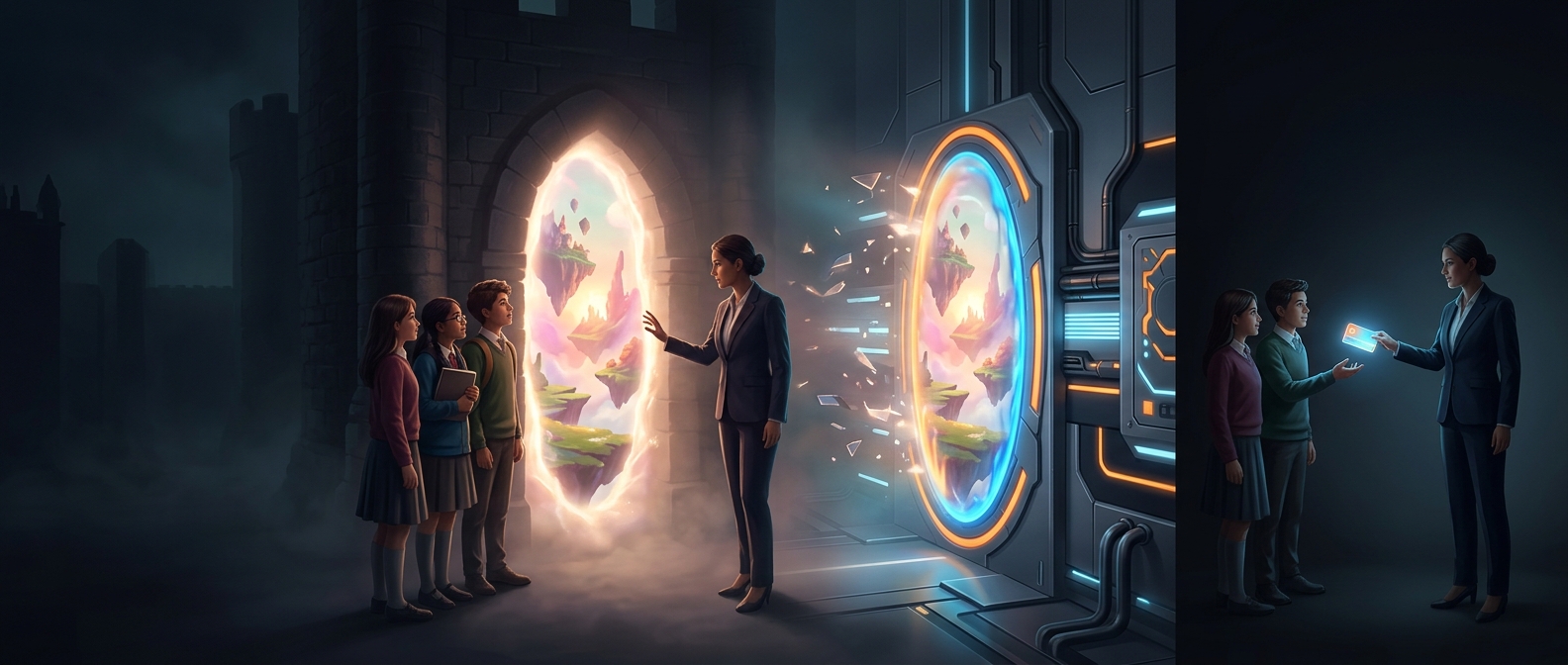
That central idea carried into Portal, developed at Valve after the Narbacular Drop team joined the company. The change was not simply a bigger setting around the same mechanic. The portal system became the organizing principle of each puzzle: rooms could be designed around lines of sight, gaps, hazards, and surfaces that invited the player to plan a route before acting.
The mechanic also made failure informative. A poorly placed portal did not usually require the player to memorize a complicated sequence; it showed that their picture of the room was incomplete. Try another angle, and the same walls and openings could reveal a path that had been invisible moments earlier.
That is why the project’s student-game origins matter. The idea was compelling not because portals looked magical, but because they gave players a consistent rule and let them discover its consequences. In Portal, escaping a room could begin with a simple realization: the way forward was already there—just not on the same side of the wall.