How motion can produce still points
A string can carry waves in both directions at once. A wave travels along it, reflects from an end, and overlaps with the incoming motion. Where the two waves repeatedly push the string in opposite directions, they cancel; where their motions reinforce, the string swings widely.
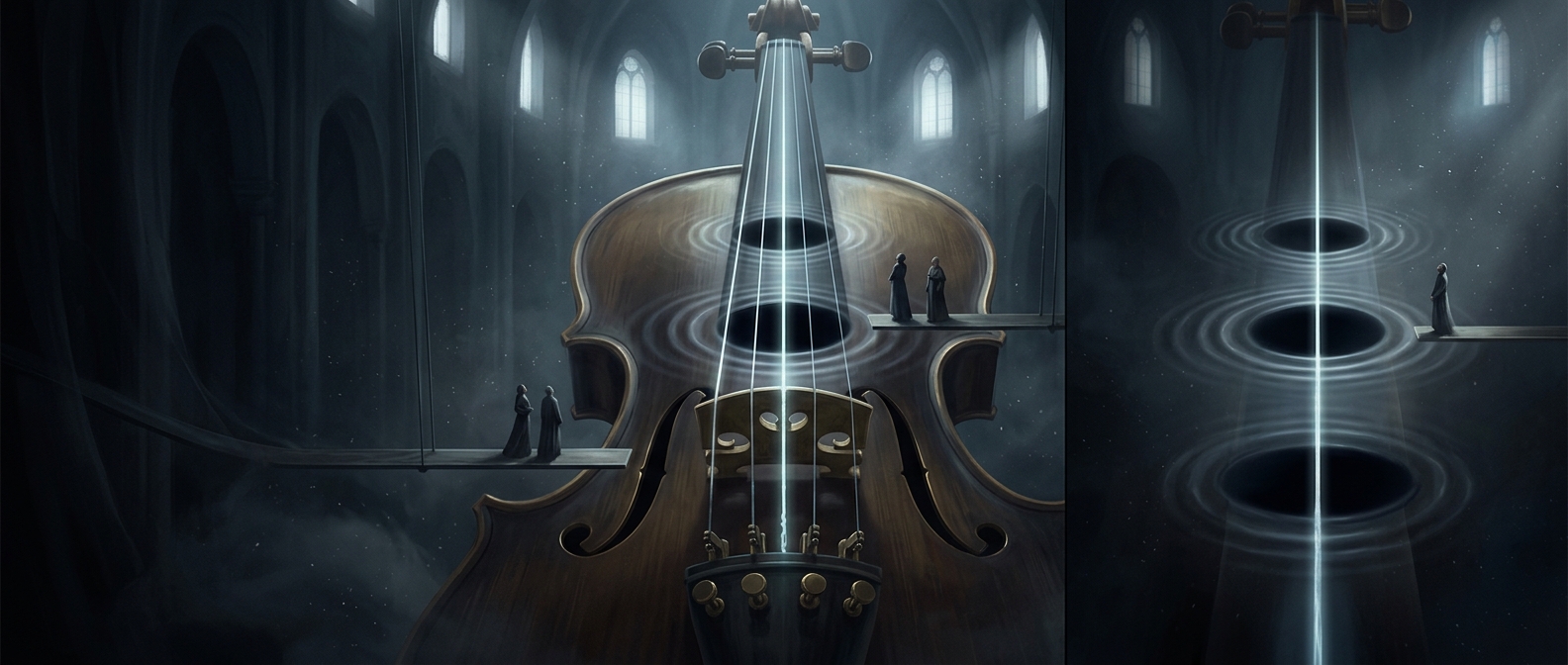
This repeating arrangement is a standing wave. Its still points are nodes, while the points of greatest movement between them are antinodes. The string is not divided into motionless pieces: every section between nodes vibrates together, in a coordinated pattern.
Why the pattern stays in place
The pattern forms when the string’s length, tension, and driving frequency fit together. A string under greater tension carries waves faster; changing its length or tension changes which vibration patterns can persist. At a suitable frequency, reflected waves return in step with the driving motion and reinforce the same pattern cycle after cycle. This is resonance.
At other frequencies, reflections arrive out of step, so the motion does not build into a clear, stable shape. The nodes are therefore not little clamps or damaged spots. They are locations where the overlapping waves keep canceling one another.
Making an invisible pattern visible
Franz Melde’s demonstration turned that timing problem into something the eye could follow. A tuning fork supplied a regular vibration to a string. By adjusting the setup, he could produce a stable pattern whose loops and still points remained in fixed positions as the string moved.
That visible arrangement reveals a broader principle: waves can combine to create structure, not just motion traveling from place to place. The same kind of reinforcement and cancellation helps explain resonances in musical instruments and vibrations in many other systems. On the string, the clearest clue is also the strangest one: the wave is active, yet its nodes stay put.