The arithmetic points to tens of millions
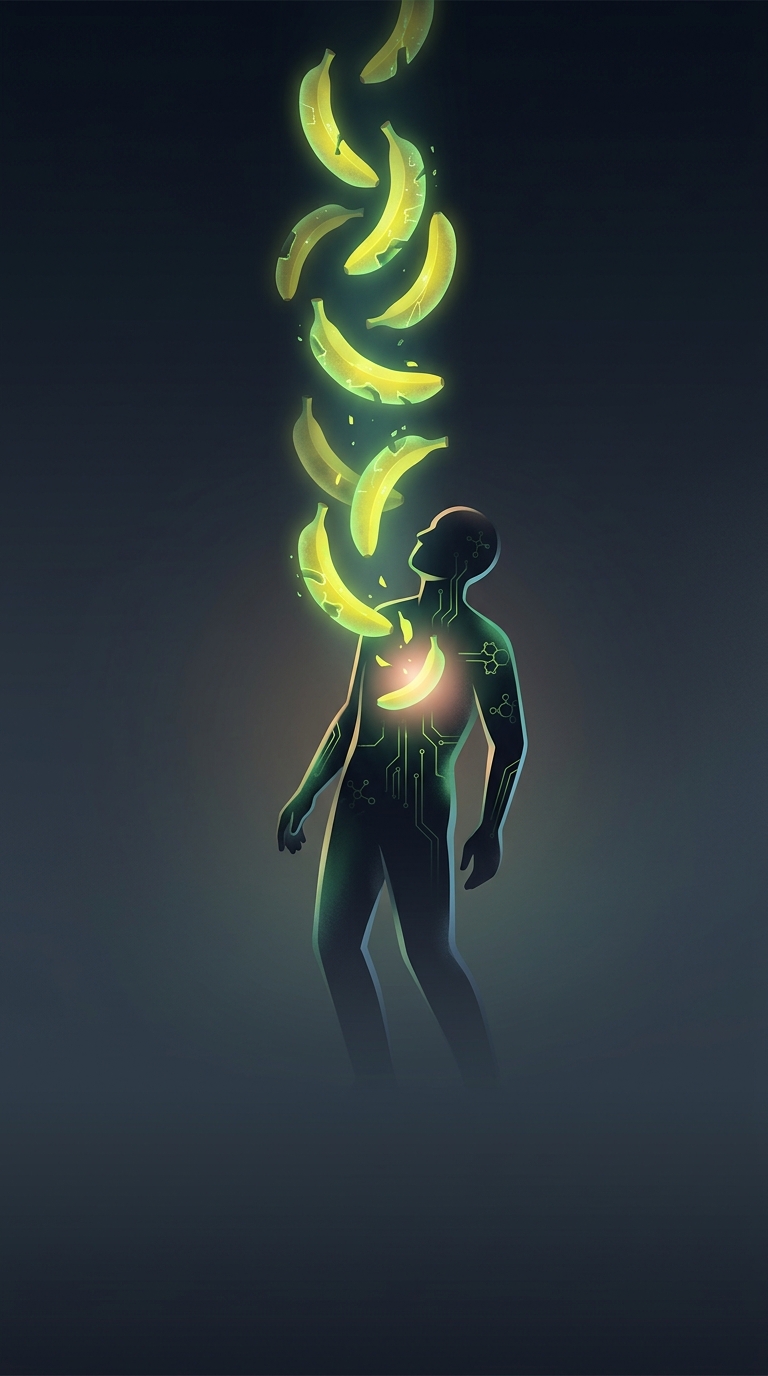
A common back-of-the-envelope comparison assigns a banana about 0.1 microsievert of radiation dose. A whole-body dose of several sieverts delivered over a short time can be fatal. Dividing those figures gives an answer on the order of tens of millions of bananas—roughly 40 million if you use 4 sieverts and 0.1 microsievert per banana.
That calculation is useful for scale, not as a real poisoning threshold. The dose from one banana comes mainly from potassium-40, a naturally radioactive form of potassium found in food and in our bodies. The comparison treats each banana’s dose as though it simply stacks onto the next.
Your body does not let the dose stack that way
Potassium is essential, so the body tightly regulates how much it keeps. Extra potassium is generally excreted, while the body’s natural potassium content—and its potassium-40—stays within a narrow range. Eating more bananas does not cause the body to retain a matching amount of radioactive potassium indefinitely.
And the sheer quantity makes the hypothetical impossible in practice: even at about 100 grams per banana, 40 million bananas would weigh around four million kilograms. You would face insurmountable problems long before radiation dose became relevant.
The real takeaway
Bananas are mildly radioactive, but “banana-equivalent” doses are a teaching comparison, not a way to calculate how many you can eat before being harmed. There is no realistic number of bananas you could aggressively eat at once that would kill you by radiation. The famous huge number describes naive arithmetic, not a plausible fatal scenario.