Why a Snowflake’s Clarity Disappears in a Snowbank
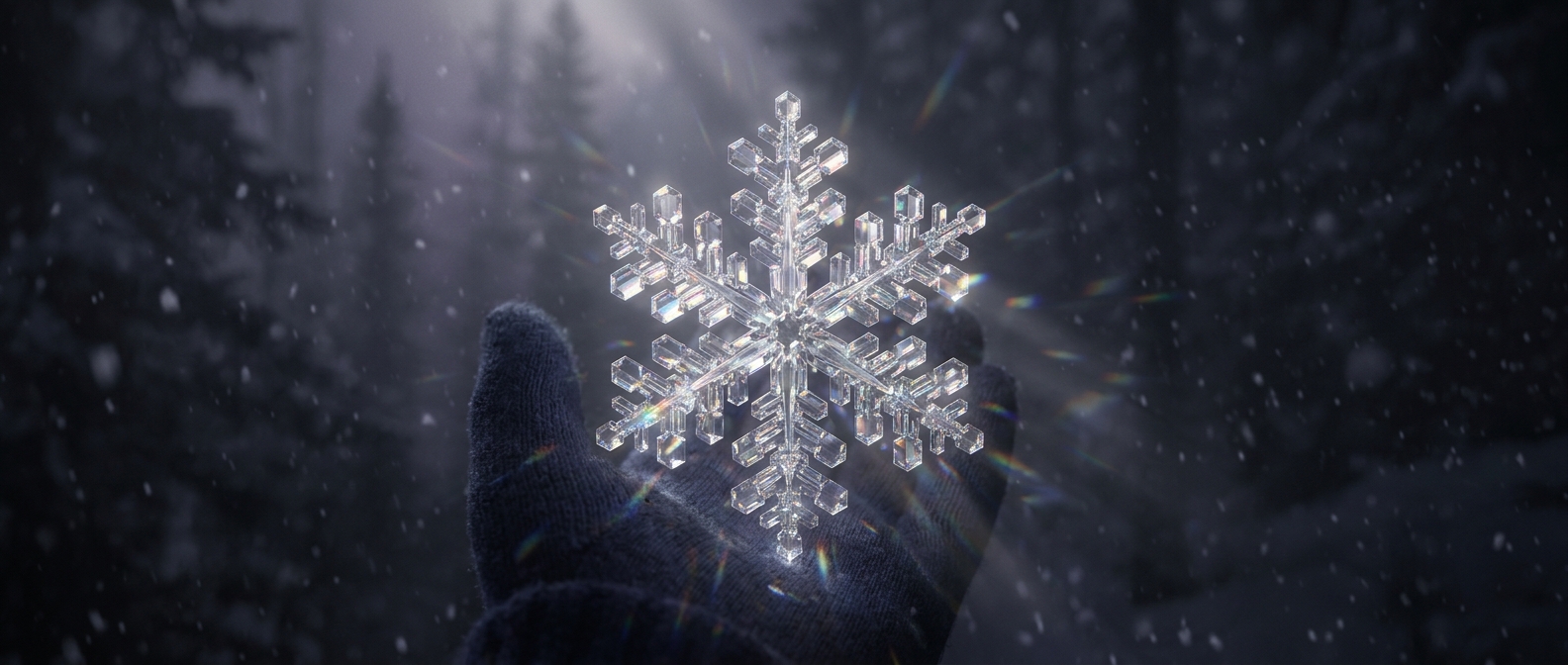
A single ice crystal is transparent because light can pass through it with relatively little disturbance. Snow, however, is not a solid block of ice. It is a loose assembly of ice grains with air-filled gaps between them. Every boundary between ice and air changes the path of light slightly, sending some of it in a new direction.
Light Takes a Crowded, Scattering Route
As light travels into snow, it encounters boundary after boundary. It may pass through one grain, reflect from another, and emerge only after many such encounters. This repeated redirection is called multiple scattering. Instead of seeing through the snow to what lies behind it, your eyes receive light that has been bounced back out of the pile.
The grains scatter the different colors of visible light broadly enough that none dominates. Their combined light therefore looks white, much as a mixture of visible colors does in daylight. The whiteness comes from the structure of the snow, not from white pigment in the ice.
Why Snow Can Look Blue or Gray
Snow does not always look pure white. In deep snow, some light travels farther before returning to the surface. Ice absorbs a little more red light than blue light over long paths, so deep snow or the blue-toned parts of a glacier can appear blue. In shade or under dim, colored light, snow can also take on gray or other tints because it reflects the light available around it.
That is why a clear ice cube and a snowbank behave so differently: the cube offers light a relatively direct route, while a mass of snow sends it on a winding journey through countless ice-and-air boundaries.