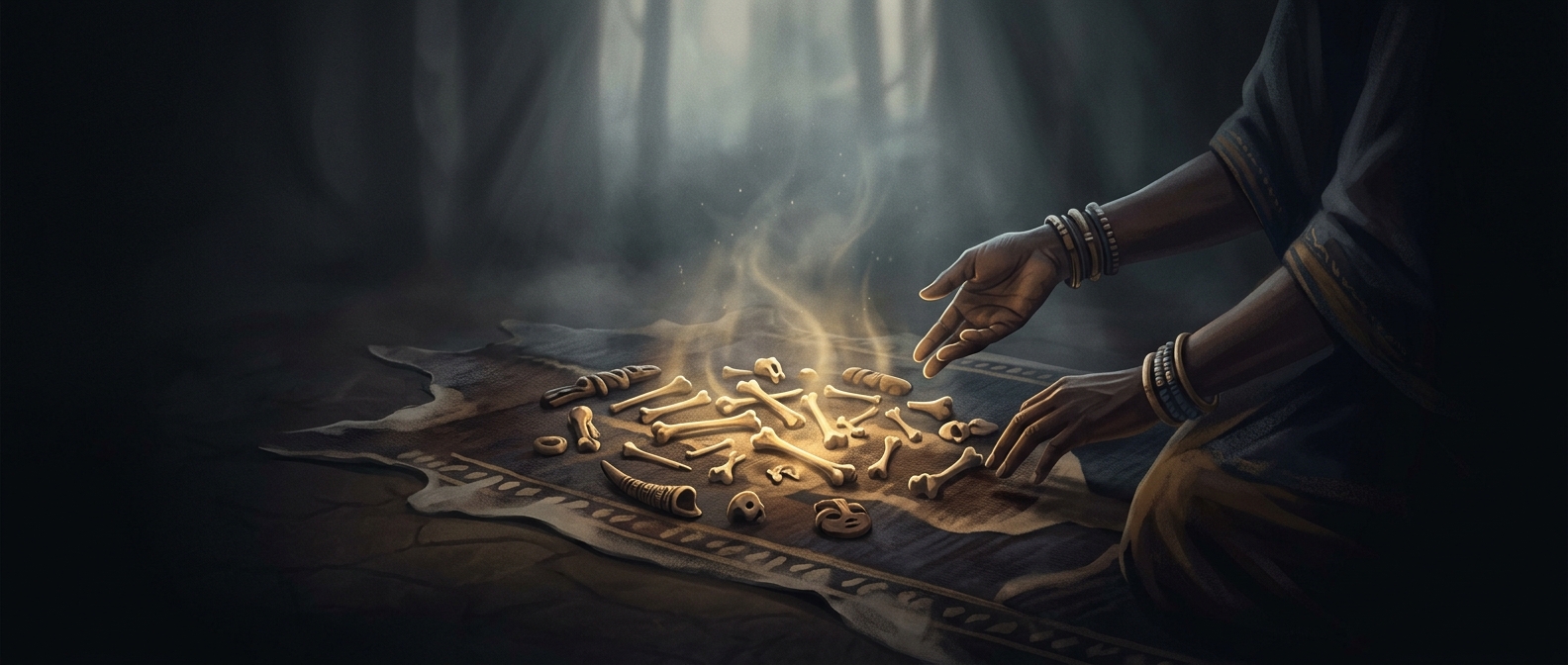
How a Scatter of Bones Becomes an Answer
Bone divination is not one uniform practice across Africa. Different communities and diviners use different objects, rules, and teachings; the meaning of a cast depends on the tradition behind it. The bones are not simply read as a picture with a universal key. They form part of a learned symbolic system.
A diviner casts a set of objects and attends to how they settle: which pieces face up, touch, or fall apart from the rest. In some practices, particular bones or other objects carry distinct associations. Their positions combine those associations into a pattern the diviner interprets in light of the person’s question and circumstances. The answer comes from the relationship between the objects, the question, and the diviner’s tradition—not from a single bone speaking for itself.
More Than a Forecast
A consultation may address what is happening now, what could happen, or what is not yet understood. That can make the reading less like a fixed prediction and more like a structured way to consider a problem: a diviner offers an interpretation, and the person seeking guidance can connect it to events, relationships, or choices in their life.
For those who practice or consult these traditions, the cast can also carry cultural and spiritual meaning. Its authority rests on inherited knowledge and the diviner’s ability to interpret the signs, rather than on a method that can be tested like a scientific instrument. The same scattered objects may therefore be meaningful within one tradition and unreadable outside it.
The striking part is how much interpretation depends on context: the cast supplies a pattern, but the question gives that pattern its human stakes.