Why Ice Plants Treat Water Before Freezing
A clear, uniform cube begins with water whose contents are controlled. Dissolved minerals can leave cloudy patches or affect taste, while particles can make ice look uneven. Packaged-ice producers therefore filter incoming water; some also use reverse osmosis, which pushes water through a fine membrane that blocks many dissolved substances.
That treatment makes the water more consistent from batch to batch. It does not, by itself, remove air that is already dissolved in the water, and filtration alone cannot guarantee a perfectly clear cube.
What Happens Inside the Freezer
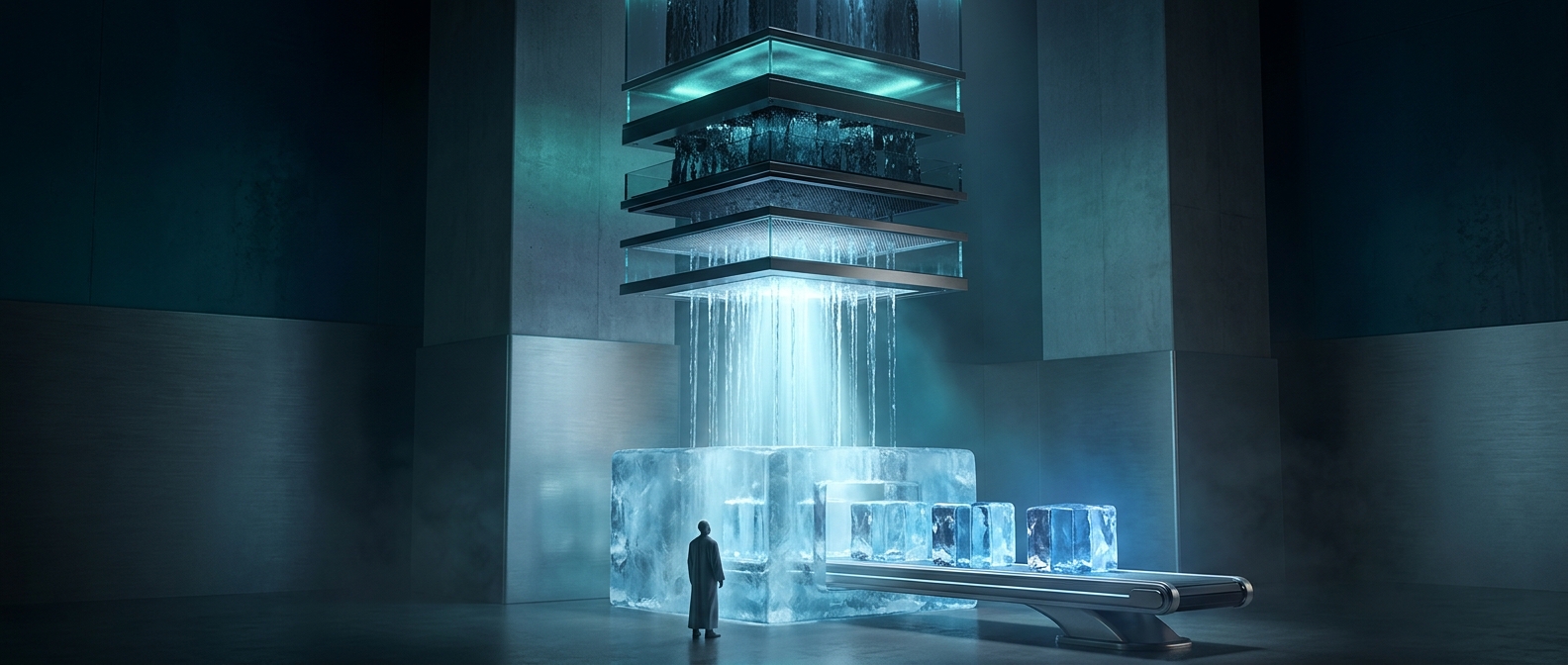
As water freezes, the growing ice crystal structure tends to exclude dissolved gases and impurities. If freezing happens from several directions at once, those substances can become trapped in the center, creating a cloudy area. Commercial equipment can manage freezing conditions to produce more consistent shapes and appearance; water treatment helps by reducing the material the freezing process must contend with.
The result is a production chain in which filtration and freezing do different jobs: treatment controls water quality, while the way the ice forms affects clarity. For packaged ice, that consistency matters because customers expect cubes that look and taste alike from one bag to the next.