Making Time Visible Before Clocks
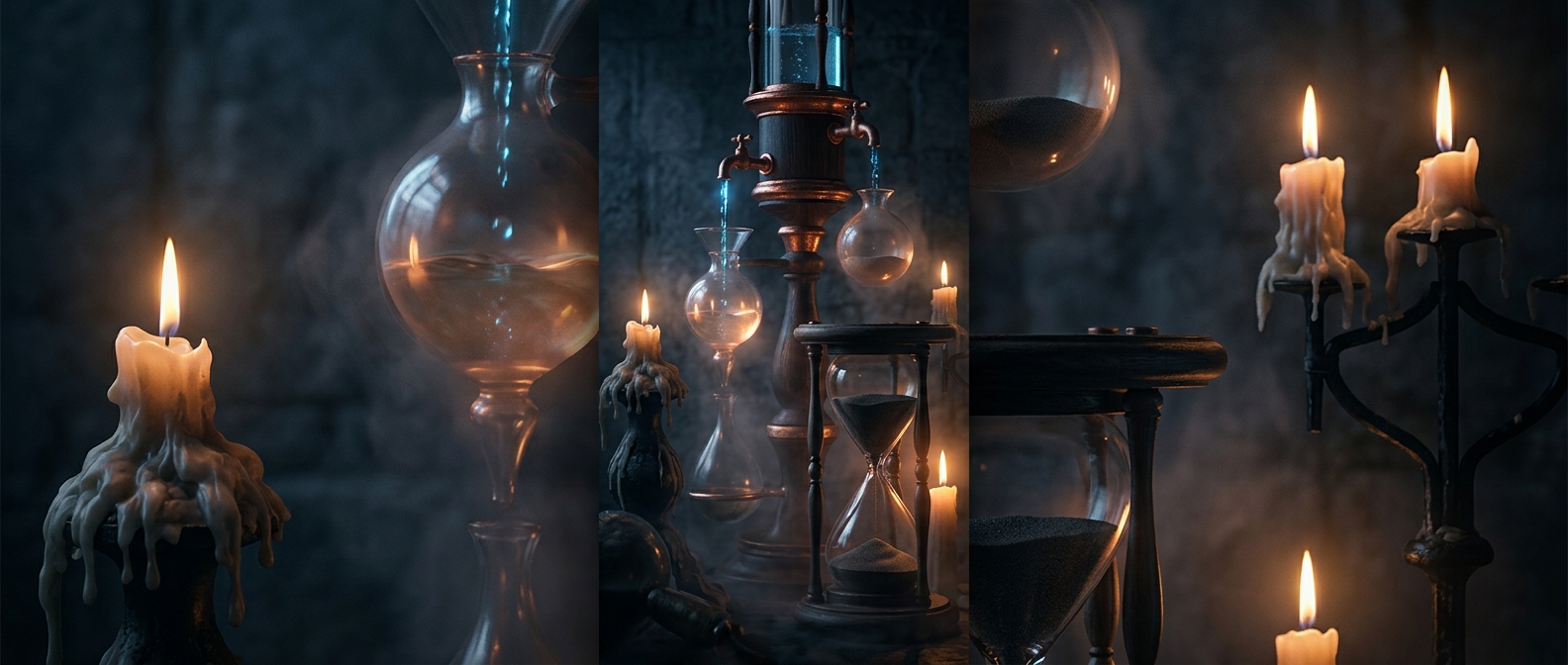
Before mechanical clocks became common, people needed ways to divide the day into intervals they could see and use. Candles, water, and sand offered a practical answer: let a material move or disappear at a roughly steady rate, then read its progress against marks or a scale.
A Candle Was a Burn-Down Timer
A candle clock was marked at intervals along its length. As the candle burned, the shrinking wax carried the flame past those marks, giving a visible estimate of elapsed time. The method worked best when the candle was made and burned consistently; drafts, changes in wick or wax, and the candle’s position could affect the rate. It was useful for timing a stretch of activity, but it did not display the hour as precisely as a modern clock.
Water and Sand Turned Flow Into a Measure
Water clocks used a vessel with a small opening. In an outflow design, water drained from a container, and its changing level—or the time it took to reach a mark—indicated how much time had passed. Other designs measured water as it collected. Sand clocks worked on a similar principle: grains passed through a narrow opening between two chambers, and the amount transferred marked an interval.
These devices depended on controlling the flow. A steady opening and consistent conditions made the measurement more useful, while changes in water level or interruptions could make it less reliable. Unlike a sundial, which needs sunlight and shows time by a shadow, candle, water, and sand timers could also be used indoors or after dark.
Time Became Something You Could Schedule
Their importance was not that every device kept perfect time. It was that a task, watch, or meeting could be assigned a repeatable interval even when the sun was unavailable. Instead of asking only where the sun stood, people could watch a flame descend, a vessel empty, or sand collect—and know that a portion of time had been used.