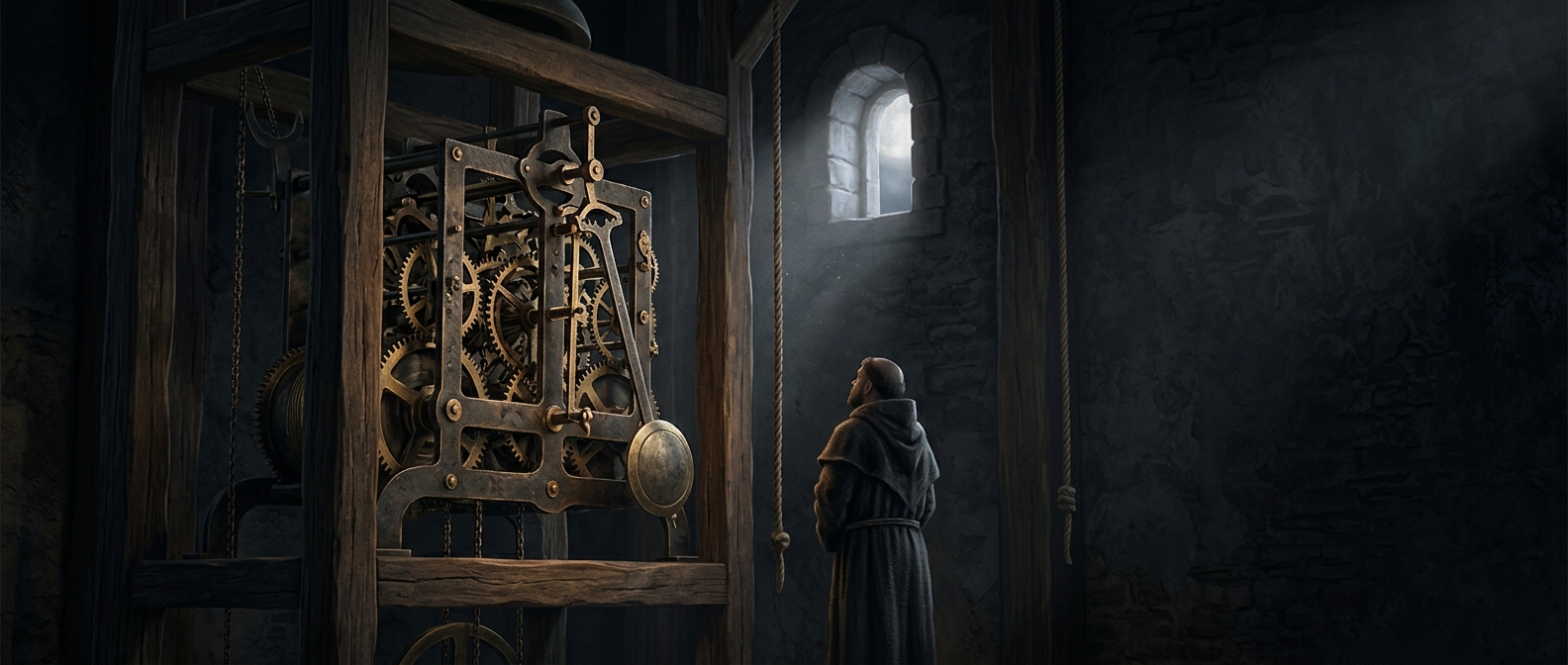
A clock you heard before you could read
The earliest mechanical clocks solved a public problem: how to make a bell ring at a chosen time without someone watching a water clock or turning an hourglass. Their gears and weights drove a mechanism that released a bell at intervals. The sound carried across a town, making the hour available to people who could not see a clock—and, in an era when few people owned one, that mattered more than a display.
The mechanism behind the chime
A clock’s moving parts needed a way to regulate the release of stored energy. In early tower clocks, a device called an escapement let a gear advance in controlled steps rather than spin freely. Those steps could operate a striking mechanism: a hammer lifted and released against a bell. The clock’s practical output was therefore a sequence of sounds, not a set of hands tracing the time on a face.
A bell also made the time communal. Its reach turned a mechanism housed in a tower into a signal for people working, trading, or gathering nearby. It announced a shared hour without requiring each listener to own equipment or know how to read a dial.
From public signal to visible time
A clock face and hands added a different kind of usefulness: they let someone check the time at a glance, and compare one moment with another without waiting for the next strike. That shift required a display linked to the same regulated motion that controlled the bell. Once clocks could show time as well as announce it, they became useful to individuals as well as communities.
The change was not simply from a crude clock to a better one. The earliest design prioritized reach: the town heard the hour before anyone could read it.