How a forklift keeps its balance under load
A forklift’s forks project forward, so a pallet’s weight creates a turning force that tends to tip the machine forward. The force depends not only on how heavy the load is, but also on how far its center of gravity sits from the front wheels. A load held farther out has more leverage, much as a long seesaw arm takes less weight to move its opposite end.
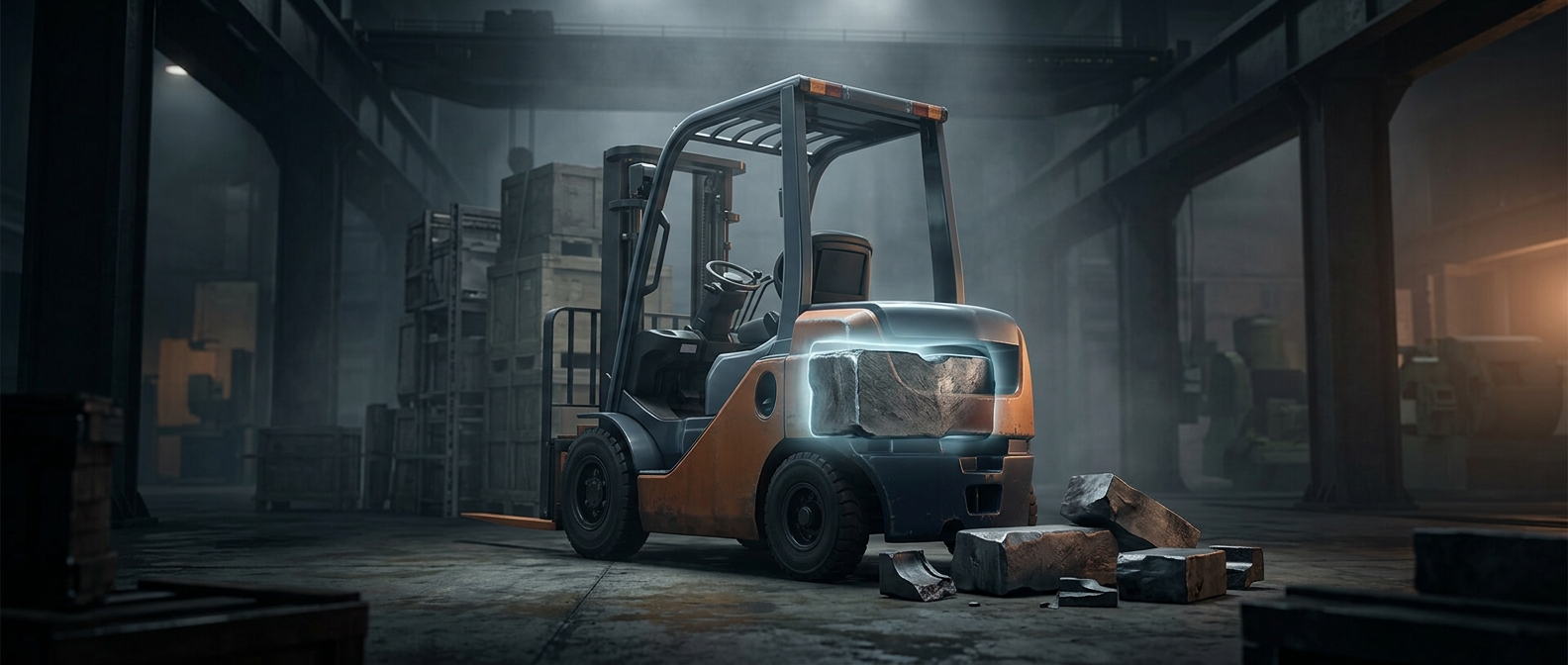
The heavy mass built into the rear of a counterbalance forklift creates an opposing turning force. Together, the truck’s weight and the load must stay within a stable range around the wheels. The rear axle can shift slightly as the truck moves, so stability is not simply a matter of balancing on one fixed point; the combined center of gravity must remain inside the forklift’s support area.
Why distance matters as much as weight
A forklift’s capacity is tied to a specified load center—the distance from the fork face to the load’s center of gravity. If a pallet is unusually deep, unevenly loaded, or carried with its weight farther forward, it can create more tipping force than a compact load of the same weight. That is why a truck’s capacity rating cannot be treated as a universal maximum for every shape of cargo.
The counterweight also has a practical cost: it makes the rear of the truck bulky and heavy. Operators need room to turn, and carrying a raised load or turning sharply can shift the balance in ways that reduce stability. The iron mass makes lifting possible, but safe handling still depends on keeping the load close, low, and within the machine’s rated limits.