Why a Pogo-Backflip Is Hard to Steer
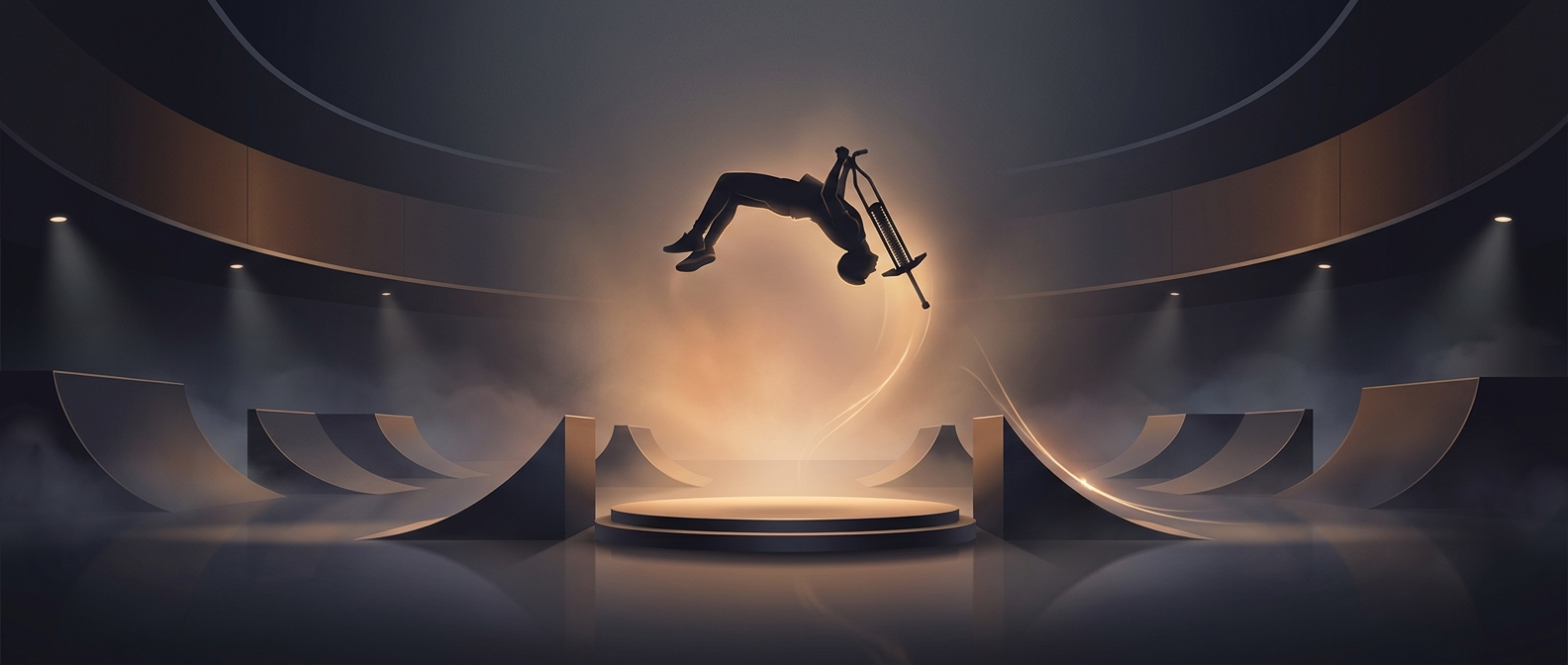
A pogo stick gives the rider a burst of upward motion, but height alone does not make a backflip. The rider has to leave the ground with enough rotational momentum—the tendency to keep turning—to complete a full revolution before landing. That rotation comes from the rider’s movement and the forces exchanged with the stick and ground during takeoff; once airborne, there is no new push from the floor to correct a weak or poorly timed launch.
The Stick Changes the Landing Problem
In a conventional flip, a gymnast can use a broad mat or a pair of feet to absorb small errors. A pogo rider has a much narrower target: the stick must meet the ground in a position the rider can control, while the rider’s feet remain on its pegs. The stick is not just equipment carried along for the stunt; its length and weight affect how the rider and apparatus rotate together.
That makes the final moment a balance problem as much as an acrobatic one. Opening the body helps reduce the spin, but the rider still has to bring the stick upright and manage the landing force through a small contact point. A rotation that looks complete in midair can still fail if the stick touches down tilted or the rider’s weight is off-center. The memorable part is not simply flipping backward—it is making a narrow, spring-loaded apparatus arrive beneath the rider at exactly the right moment.