How a lens turns the whole sky into a circle
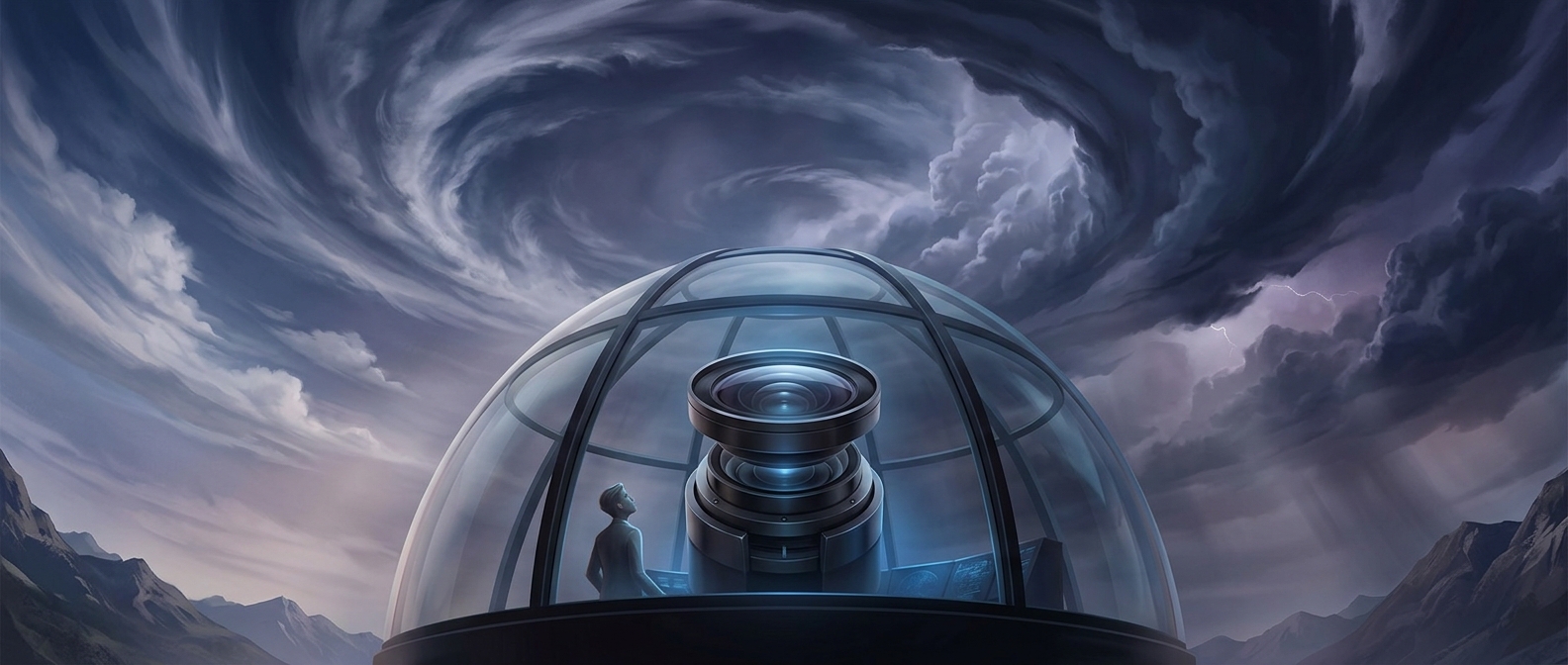
A conventional camera lens captures a relatively narrow slice of a scene. A fisheye lens bends light from an exceptionally wide field of view—often close to a hemisphere—so a camera pointed upward can record nearly the entire sky in one frame. The sky appears as a round image, with the horizon near its edge.
That coverage came with a tradeoff: the lens could not preserve the familiar geometry of a flat photograph. It squeezes a broad, curved world onto a flat sensor, so straight lines near the edges bow dramatically. The distortion is not an accident added later; it is part of how the lens fits so much of the scene into the frame.
Why the distortion suited skate videos
For meteorologists, the wide view made it easier to compare clouds across the sky without stitching together multiple photographs. In skate footage, the same optical effect gives a close-up scene an exaggerated sense of space: a skater can loom large in the foreground while the ground and surroundings curve away around them.
That look also changes the feeling of motion. As the camera follows a trick, the bent edges make the environment seem to sweep and flex, turning a practical way to capture a huge area into a distinctive visual style. The fisheye’s signature look is therefore tied to its original engineering bargain: more of the world in one image, at the cost of straight lines.