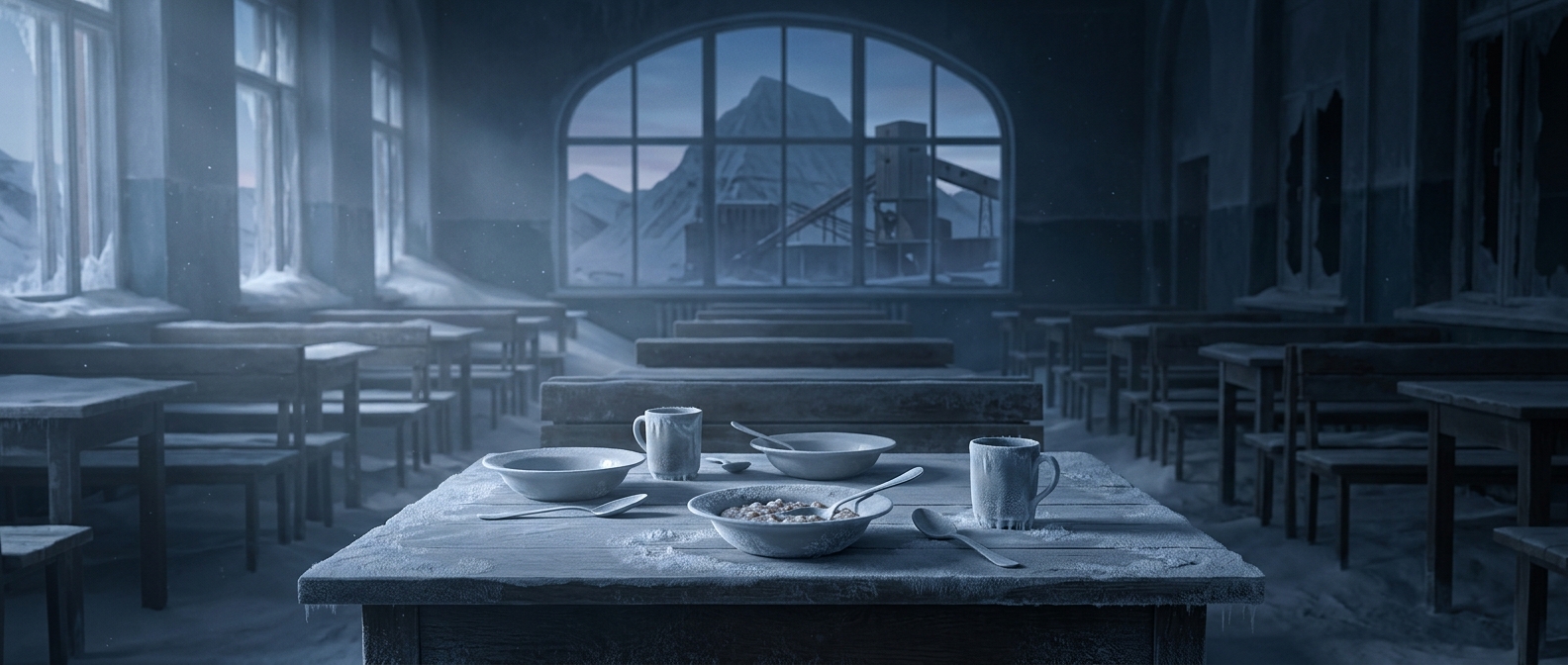
A town organized around one purpose
Pyramiden was more than a cluster of miners’ homes. In a remote Arctic settlement, daily life depended on the mining operation and on services arranged around it. Communal facilities—such as a cultural center and swimming pool—helped make a company town function through the long, isolated seasons. They also reflected a Soviet model in which work, housing, and social life were planned together rather than left to grow separately.
That arrangement created a sharp dependency: when the mine stopped operating, the town had little reason to remain. The buildings could still stand, but the system that gave them users—miners, families, staff, and the routines connecting them—was gone. A pool is ordinary infrastructure while people swim in it; without them, it becomes evidence of how much support a functioning settlement once required.
What an empty interior preserves
The surviving interiors make the disappearance legible in a way that an abandoned industrial site alone would not. They show the intended shape of everyday life: not just extracting coal, but providing places to gather, exercise, and spend time away from work. Their presence is not proof that life there was easy or ideal. It is a record of the institutions built to make a difficult, purpose-built settlement livable.
Pyramiden’s eerie quality comes from that mismatch between design and use. The town’s spaces still imply a schedule and a community, but the people who would have animated them are absent. What remains is a physical outline of a whole social system whose central activity—and therefore its reason for being—ended.