How a question becomes a hexagram
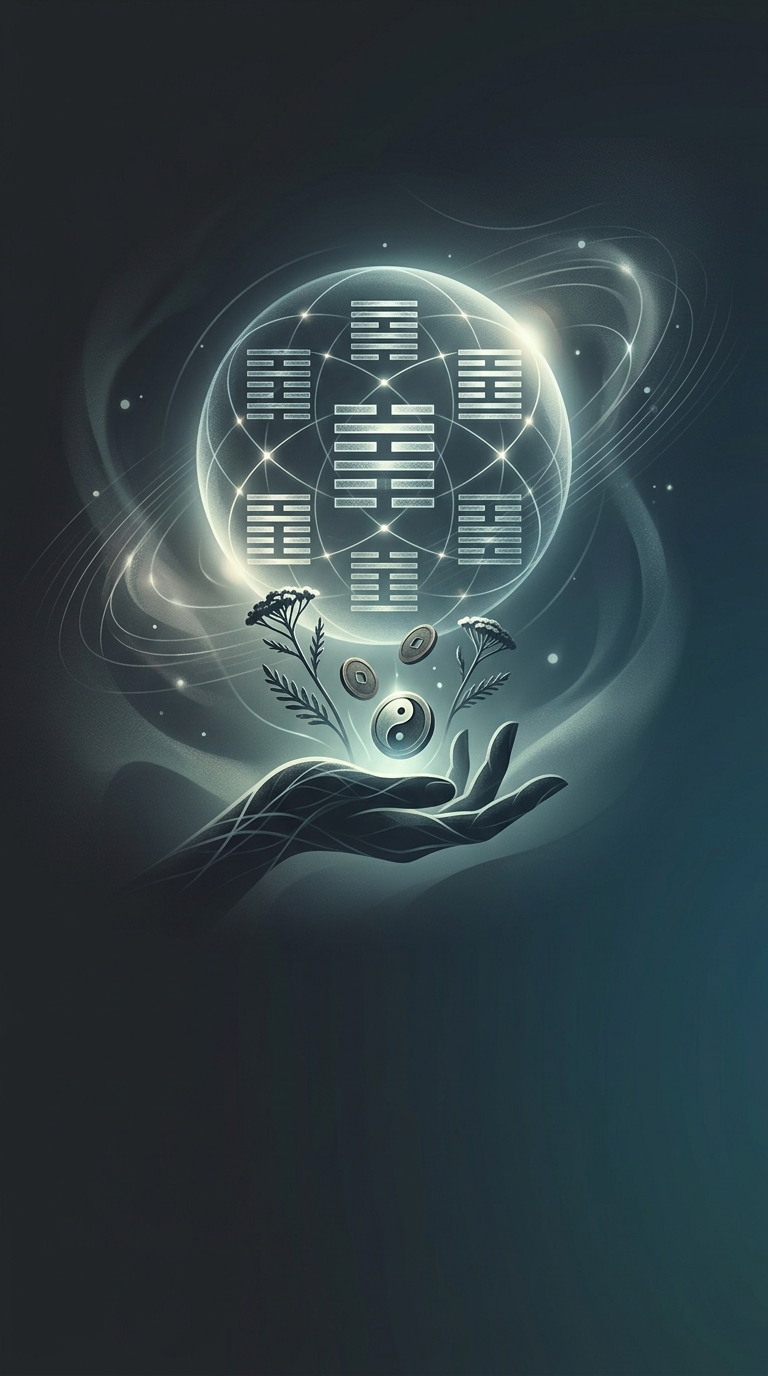
The I Ching does not produce a sentence naming what will happen. A casting produces six lines, built from the bottom upward. Each line is either solid or divided; six positions create one of 64 possible patterns, called hexagrams. Coins offer a relatively quick way to determine each line, while the older yarrow-stalk procedure uses a longer sequence of counting and sorting.
Some castings also mark lines as “changing.” These lines transform the first hexagram into a second, giving the reading a built-in sense of movement: a situation is understood not only as it stands, but as it may be shifting. The accompanying text offers judgments and brief line-by-line passages for interpreting the pattern.
Why the text invites interpretation
The passages are compact and often use images rather than explicit instructions. A reader has to connect those images to the question at hand. That makes the I Ching less like a lookup table with one fixed answer and more like a framework for considering a situation from several angles—its present conditions, its pressures, and possible changes.
This openness is part of how the book could serve different kinds of questions across time. A passage about restraint or favorable timing could be applied to a decision without claiming to predict every detail of its outcome. The casting supplies a pattern; the reader supplies the circumstances and judgment.
A ritual as well as a reading
The method matters because consulting the book is an act of procedure, not simply opening to a random page. Counting stalks or tossing coins turns a private uncertainty into a pattern that can be examined. In its early setting, that process belonged to practical and ritual life, including decisions about seasons and relations with ancestors; later readers also used the text as a guide to conduct and change.
The memorable idea is that an answer need not be a prediction. In the I Ching, a set of six lines can instead prompt the question: What is changing here, and how should I respond?