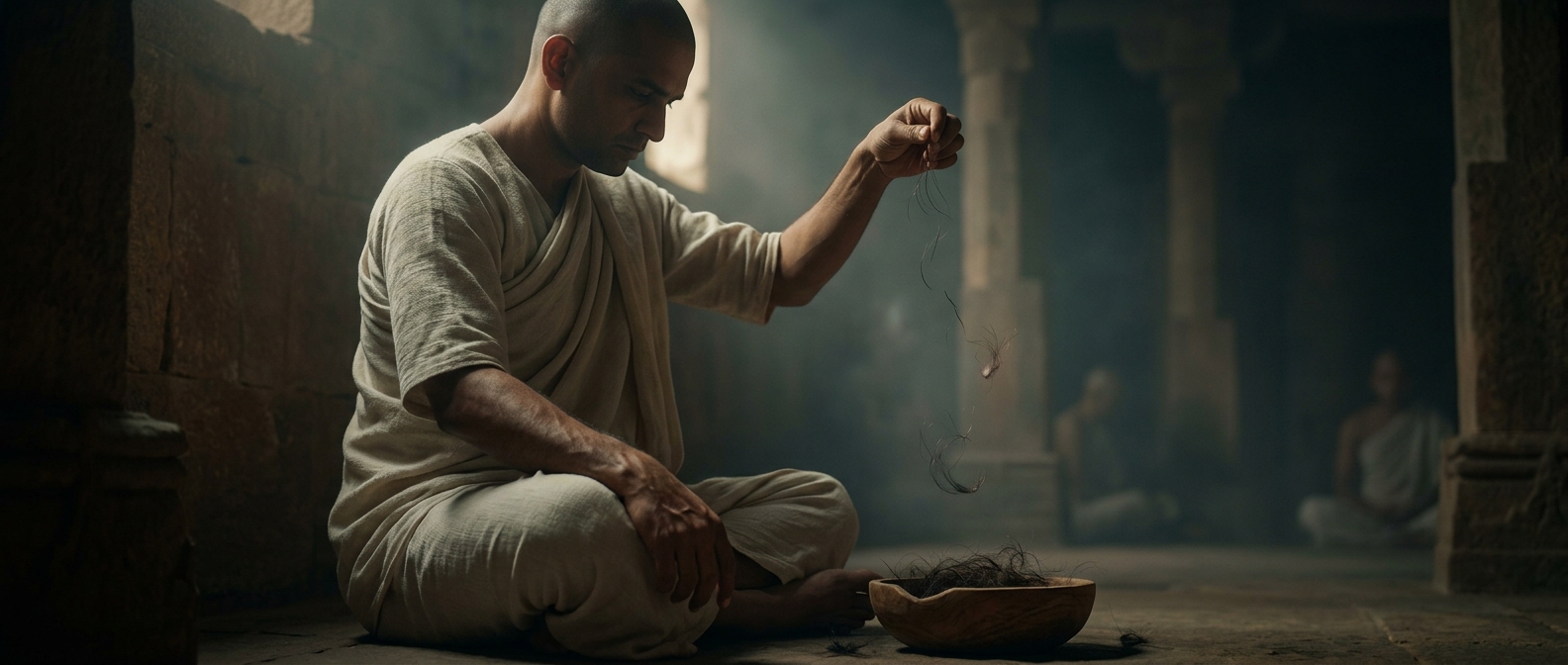
A Cage as a Deliberate Limit
For Upasni Maharaj, the bamboo cage made renunciation physical. Instead of merely resolving to care less about comfort, he placed himself in a space where ordinary choices—stretching out, moving freely, or finding shelter from the weather—were sharply restricted. The discomfort was not incidental to the practice; it was the condition he chose to face.
In Indian spiritual traditions, austerity means voluntarily accepting hardship as a discipline. It can be understood as a way to loosen the hold of habit and desire: when comfort is unavailable, a person must confront how strongly the mind reaches for it. The cage turned that inward effort into a visible, daily constraint.
What the Practice Could—and Could Not—Prove
The act also gave a concrete form to the idea of detachment from ego: the sense of self built around preference, status, and control. Confinement did not automatically erase those attachments, but it made comfort and freedom harder to take for granted. Its significance lies in the discipline Maharaj undertook, not in treating suffering itself as proof of spiritual attainment.
That distinction matters. A severe ascetic practice is not a general prescription, and the story does not require readers to accept supernatural explanations. Its striking detail is simpler: for more than a year, a spiritual discipline associated with inward detachment took the form of a cramped physical boundary, encountered day after day.