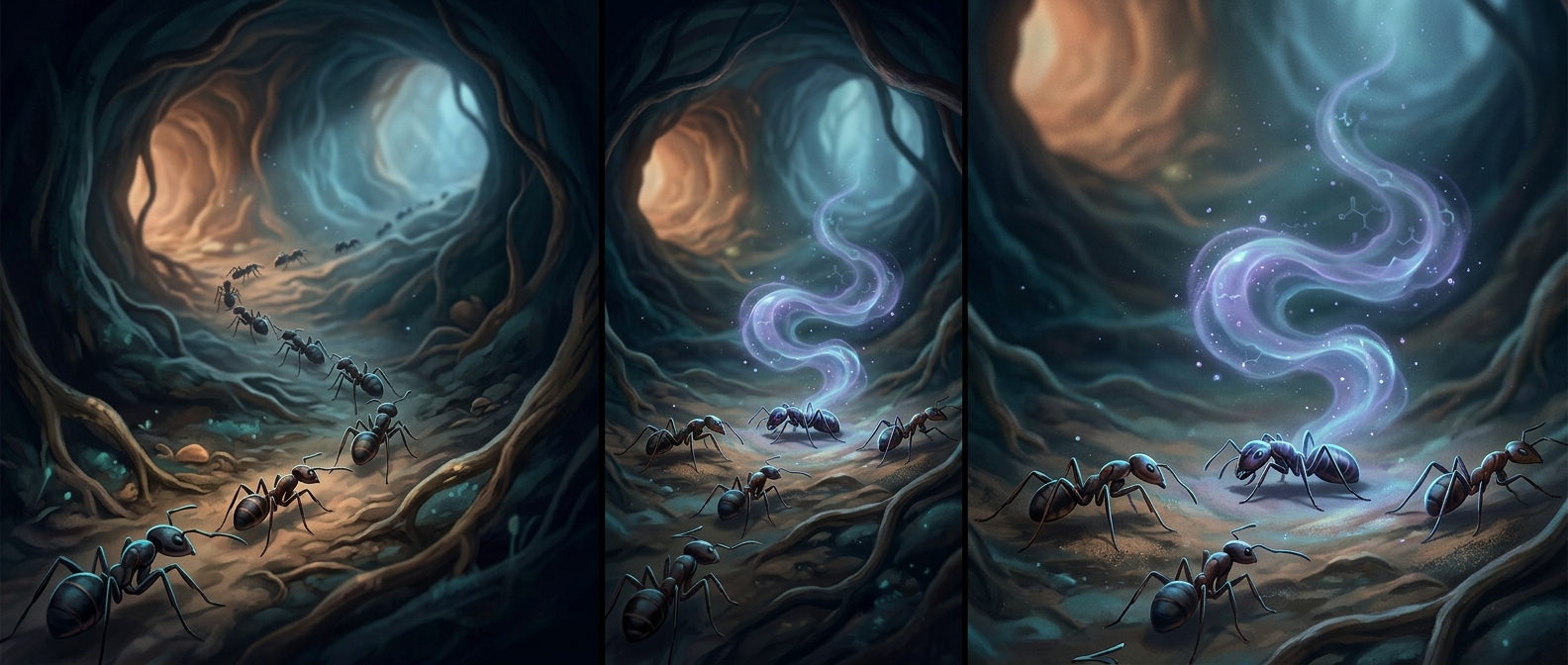
How an ant trail turns discovery into a group route
A food-carrying ant returning to its nest can deposit tiny amounts of a chemical signal called a trail pheromone. Other ants detect the scent with receptors on their antennae and follow it, often laying down pheromone themselves as they travel between nest and food. The trail is not a map or a command: it is a local cue that helps each ant decide where to go next.
Reinforcement makes useful paths stand out
When food is abundant and ants keep making successful trips, repeated traffic adds more pheromone to the route. A stronger signal attracts more followers, whose trips strengthen it further. This feedback can quickly turn one ant’s discovery into a busy supply line without any ant directing the whole colony.
The process can also favor efficient routes. If ants encounter two paths to the same food, they may reach the nearer one sooner and reinforce it more often. That can make its signal stronger, drawing still more traffic. The result is not necessarily a perfectly calculated shortest path; it emerges from many ants responding to what they smell and experience.
Why the trail disappears
Pheromones do not last indefinitely. They spread out or evaporate, and some trail chemicals break down over time. If food runs out, fewer ants make successful return trips, so the route gets less reinforcement while its scent continues to weaken. Eventually, the signal no longer stands out enough to guide many ants.
That decay matters: it prevents the colony from investing indefinitely in a route to a depleted meal. The trail is a temporary piece of infrastructure, maintained by traffic and allowed to vanish when the payoff disappears.