The breakthrough was control, not distance
A powered machine can leave the ground and still be little more than a projectile. The Wright brothers’ crucial problem was making an aircraft respond to its pilot: tilt to turn, raise or lower its nose, and keep the wings from slipping into a dangerous roll.
Their Flyer used three linked controls. A movable elevator at the front changed the aircraft’s pitch—nose up or down. A rear rudder helped point it left or right. And a system that twisted the wings, called wing-warping, tilted one side to help the machine bank into a turn. The controls mattered together: a turn required managing both the aircraft’s direction and its balance.
A short flight built on years of testing
The Flyer was not a sudden leap from workshop to sky. The brothers had spent years experimenting with gliders, observing how air moved over wings and learning how small control changes affected a flight. Each test could expose a new problem; the next design had to address it.
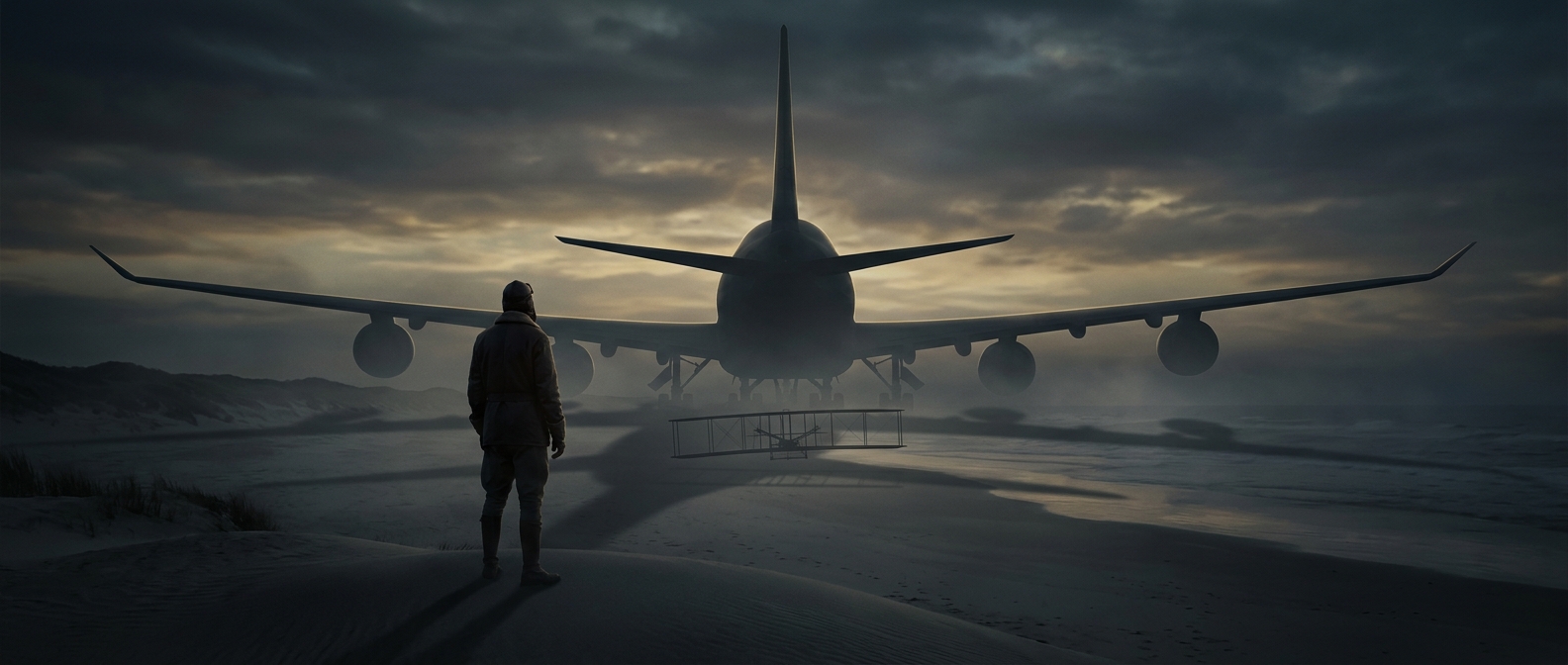
That work shaped the 1903 flight’s importance. Its brief airborne run showed that the machine could be powered and guided, rather than merely lifted by a gust or sent forward without control. It did not establish that airplanes were already practical for travel: reliability, endurance, and useful payloads remained challenges. But it demonstrated a workable way for a pilot to manage an aircraft in the air—a principle later airplane designers could build on.
The telling measure of the first flight is therefore not how far the Flyer went, but that its pilot could influence where it went at all.