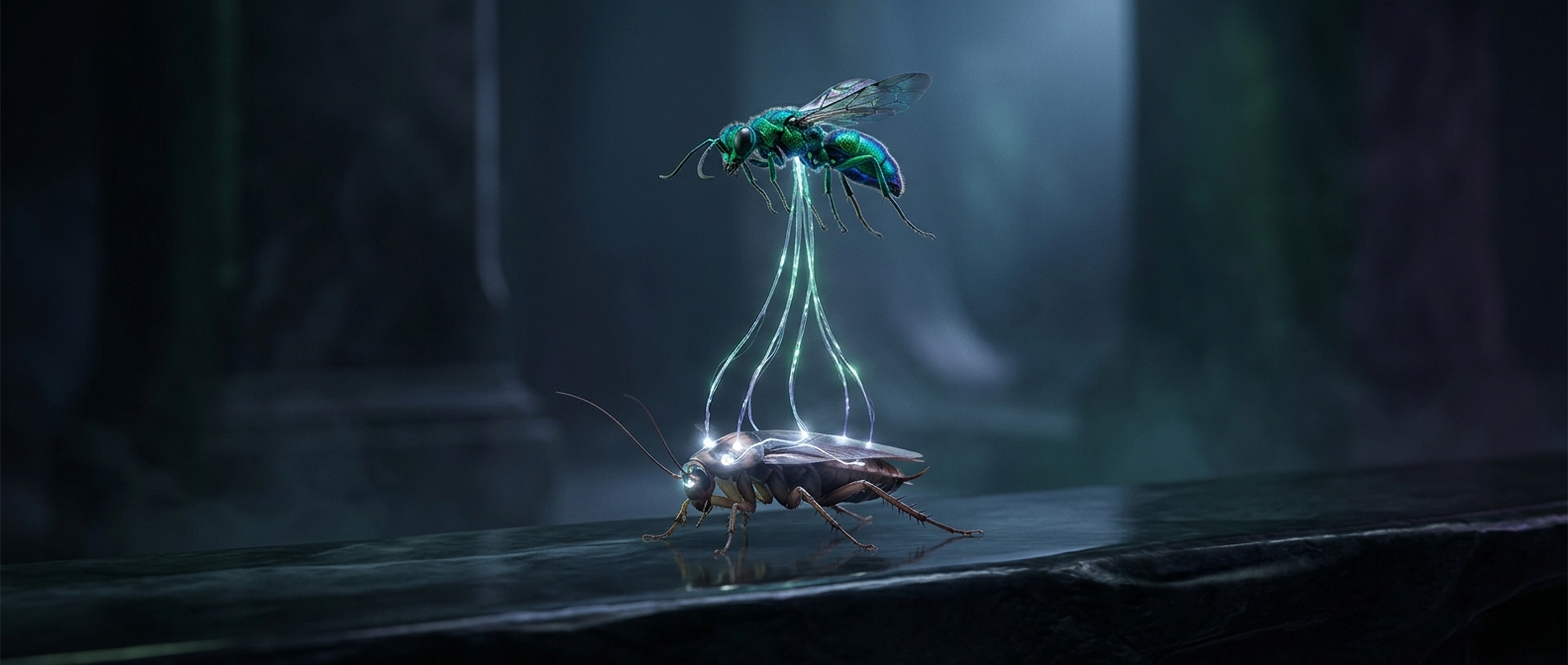
How a jewel wasp disables a cockroach’s escape response
The jewel wasp does not immobilize its victim like a venomous spider. It uses a carefully placed sting to alter what the cockroach does. After a sting to the body helps restrain the roach, the wasp stings its head and delivers venom into the brain region that helps govern movement and escape.
The venom does not simply switch off the roach’s muscles. The cockroach can still walk; what changes is its drive to flee. Researchers have linked the effect to altered activity in brain circuits involved in movement, but the practical result is easier to see than to describe: a normally evasive insect becomes unusually passive.
Why the wasp leads it by an antenna
A wasp too small to carry a cockroach cannot drag it like prey. Instead, it grips one antenna and walks toward its nest, while the roach follows. The antenna serves as a guide handle, and the roach’s reduced escape response makes this slow escort possible.
That behavior is not proof that the cockroach has lost all awareness or control. It is a living animal with functioning legs, but its usual urge to break away has been profoundly disrupted. That distinction is what makes the wasp’s strategy so effective: it changes the victim’s behavior rather than simply overpowering its body.
The sting makes a nest possible
At the nest, the wasp lays an egg on the cockroach. The larva hatches and feeds on the still-living host, eventually entering its body. The host’s continued life provides the larva with food while the wasp’s nest keeps the prey contained.
The remarkable part is the sequence: a targeted sting turns a fast, defensive insect into a mobile but compliant food source. The roach can still walk; what it has lost is the instinctive getaway that would make walking useful.