Why cells keep reusing ancient tools
A cell must solve a few basic problems to stay alive: copy its DNA before dividing, read genes to make proteins, and control when division begins. These tasks depend on molecular tools—enzymes and other proteins—that interact in precise ways. If a change breaks one part of a tightly connected process, the cell may fail to grow or reproduce.
That creates evolutionary pressure to preserve the parts that work. Across generations, small changes can accumulate, but the core machinery often remains recognizable. The same broad principle applies in human and banana cells: both use DNA, RNA, and proteins, and both rely on inherited molecular systems to manage genetic information and cell growth.
Shared parts do not mean identical systems
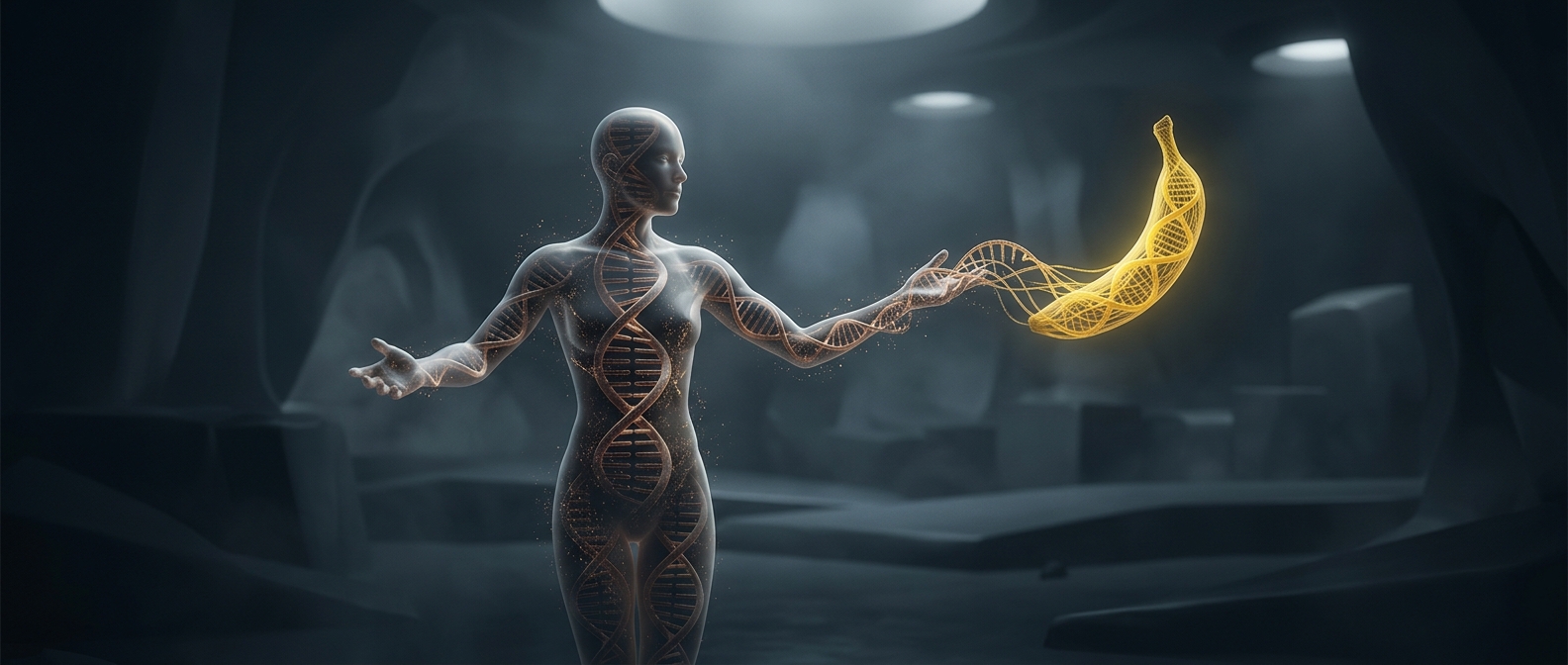
The resemblance is at the level of particular genes and cellular processes, not a claim that a banana is genetically half human. Each organism has its own genome, and many genes do different jobs or have no close counterpart in the other. Even where a gene is shared, its sequence and role can vary.
Scientists can compare these genes because DNA provides a record of biological inheritance. Similar versions of a gene in two species can point to an ancestral version that existed before their evolutionary lineages separated. Over time, descendants altered that inherited toolkit in different ways, while retaining components that remained useful.
This is why a fruit and a person can share some of the same basic cellular machinery without being close relatives. The shared tools are not a special resemblance between humans and bananas; they are durable pieces of a much older biological toolkit. A banana cell can use that toolkit to grow a plant, while a human cell uses related components to build and maintain a very different body.