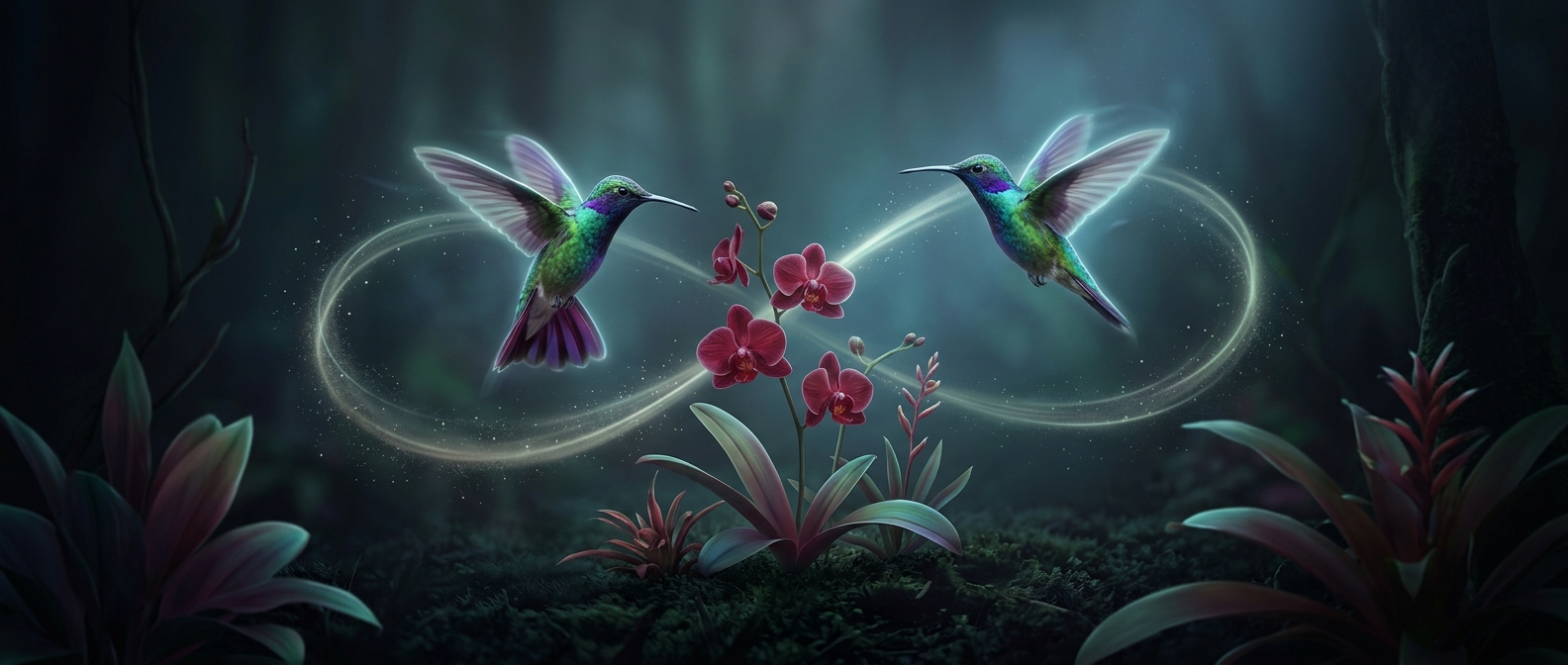
How a Hummingbird Makes Both Strokes Count
Most birds get most of their lift from the downstroke: the wing presses air downward, and the bird is pushed upward in return. A hummingbird’s hovering flight depends on a different arrangement. Its wings move rapidly back and forth, and at each end of the stroke the wing twists so its surface meets the air at a new angle.
That turn changes what the wing does on the way back. Rather than simply folding or returning passively, it sweeps through the air in a sideways figure-eight path. The wing’s rotation lets the upstroke also push air downward, producing lift instead of serving only as a reset.
The Turn Is the Key
The figure eight is not just a drawing of the wing’s path. It reflects a coordinated sequence: the wing changes direction, rotates, and then makes its next pass. By presenting the wing at an effective angle during both halves of the cycle, the bird keeps moving air downward throughout the beat.
This is especially useful while hovering, when the bird cannot rely on forward travel to help its wings generate lift. It must continually counter gravity in place, while also making small adjustments to remain steady or shift position. Using both strokes helps provide the continuous support that task demands.
The result is not a perfectly identical push in each direction, but a flight cycle in which neither half is merely wasted motion. A hummingbird can hold its position at a flower because its wings keep producing lift even as they reverse course.