A stranded expedition needed more than a prediction
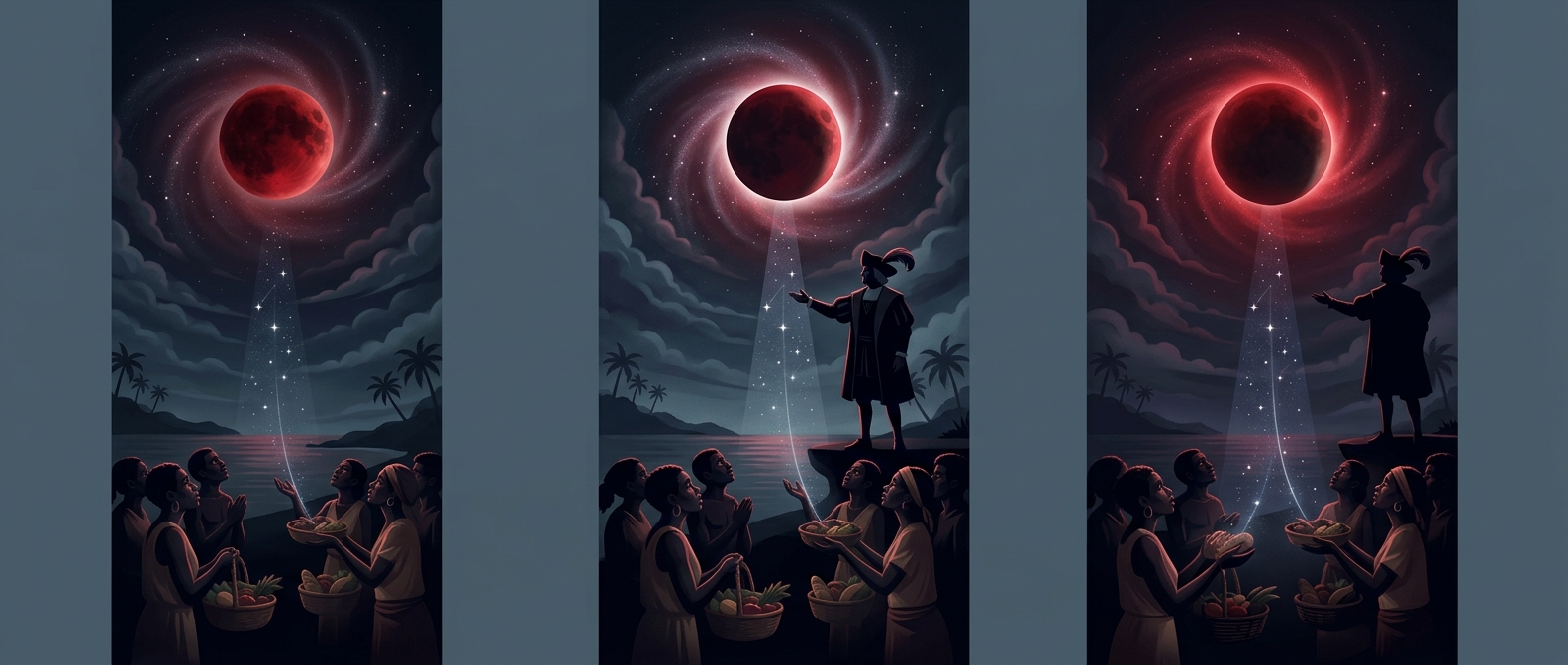
In 1504, Columbus and his crew were stranded on Jamaica after their ships became unseaworthy. Their survival depended on food supplied by local Taíno communities, but relations and provisions had become harder to maintain. Columbus had an astronomical almanac that gave advance dates for eclipses. He turned that practical information into leverage.
Rather than simply predict the coming lunar eclipse, Columbus presented it as a sign of divine anger and warned local leaders that the moon would be taken away unless they restored the food supply. The threat reframed a dispute over provisions as a confrontation with a power they could not see or control.
Turning the sky into a demonstration
A lunar eclipse occurs when Earth passes between the sun and the moon, casting its shadow across the moon. The moon does not usually vanish all at once: it gradually darkens, and sunlight filtered through Earth’s atmosphere can make it appear reddish. Because the event follows predictable celestial motions, an almanac could tell Columbus when to expect it.
When the eclipse began, the visible change gave his warning force. Columbus then used its return to brightness as part of the same performance, presenting the end of the darkness as evidence that the danger had passed. The food supply was restored, according to accounts of the episode.
The episode’s striking lesson is not that Columbus controlled the eclipse, but that he controlled the timing and interpretation of it. A calendar turned a predictable astronomical event into a bargaining tool—and the moon became a public demonstration staged during a crisis of survival.