Why the front wheel kept growing
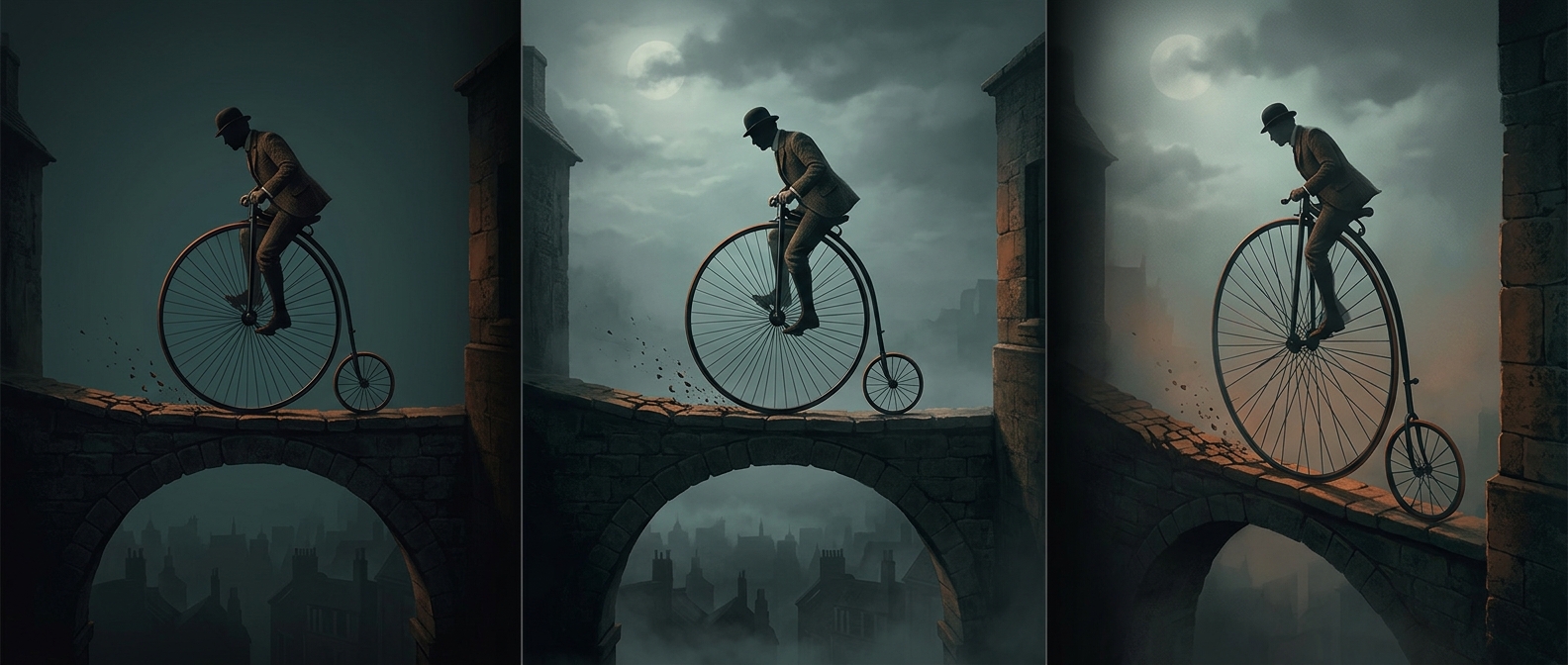
On a high-wheeled bicycle, the pedals turned the front wheel directly. There was no chain to multiply the rider’s effort: one pedal revolution meant one wheel revolution. Making that wheel larger let the bicycle cover more ground with each turn, so riders could travel faster without pedaling at an impractical rate.
But the design put the rider’s weight high above the wheel that also steered and drove the machine. The saddle sat close to the front axle, leaving little room for the rider to absorb a sudden stop by shifting backward.
A small obstacle, a large rotation
When the front tire met a rut, stone, or other obstacle, the wheel could slow sharply while the rider’s body continued forward. Because the rider was perched above and ahead of the rear wheel, that continuing motion tipped the bicycle around its front axle. The higher the rider sat, the more dramatic the fall could be.
This was not simply a matter of poor balance. The geometry made a forward pitch an especially unforgiving failure: the very large wheel that delivered speed also placed the rider in the path of the rotation. Riders could reduce risk by choosing smooth routes and controlling their speed, but they could not remove the basic tradeoff.
The safer layout changed the bargain
The later “safety bicycle” used two wheels of similar size and a chain to drive the rear wheel. Gears allowed the pedals to turn faster than the wheels, so speed no longer required an enormous front tire. With the rider seated lower and between the wheels, the machine was less likely to pitch the rider forward when the front wheel stopped.
The high wheeler’s design made speed visible in its towering front wheel. Its successor made speed a matter of gearing—and put the rider closer to the ground.