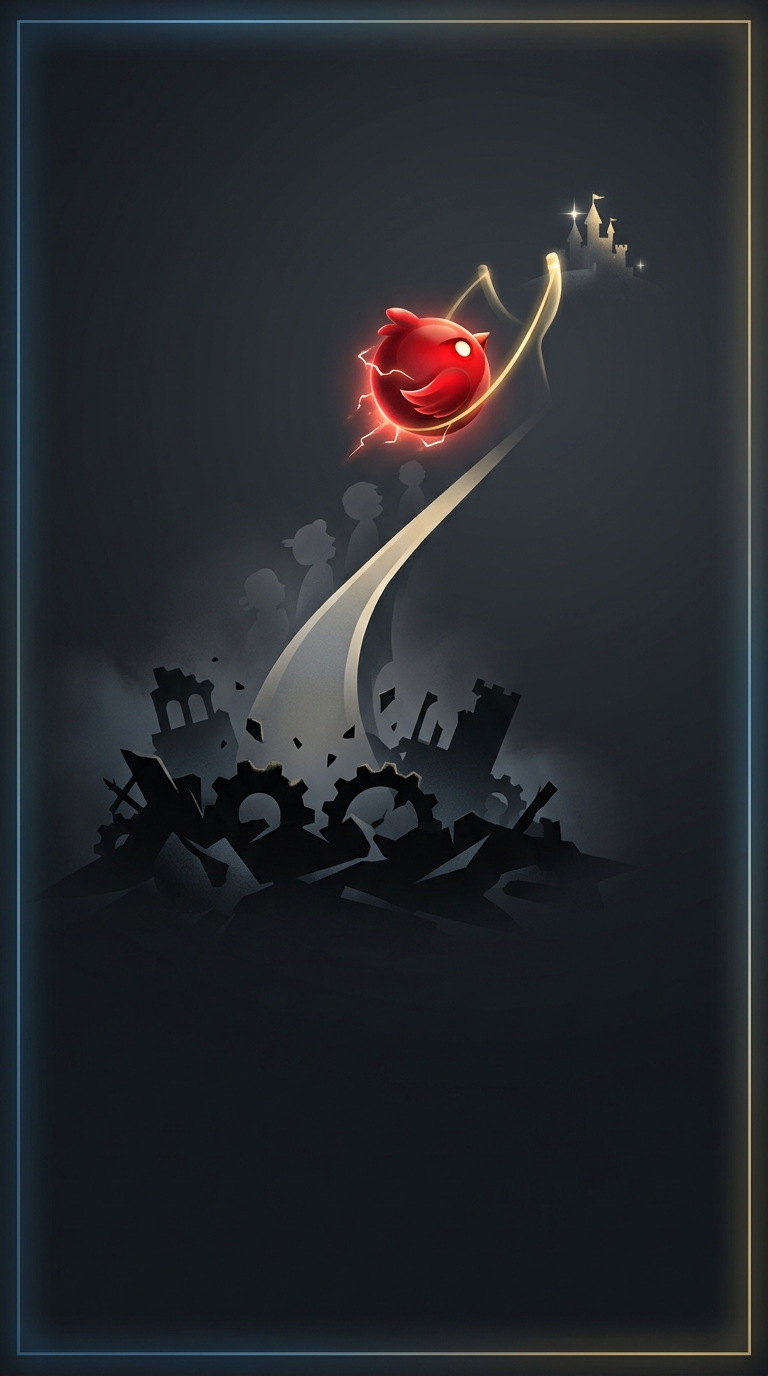
A sketch became the game’s clearest visual idea
The first grumpy, wingless bird offered a useful design constraint: it could not simply fly toward its target. In Angry Birds, the player instead pulls a bird back in a slingshot and lets it arc through the air. The character’s lack of wings fits the action, while its compact, expressive shape stays easy to recognize on a small screen.
That simple setup also makes the player do the work of imagining a solution. A shot can be aimed high to drop onto a structure or low to smash through it. The bird’s flight and the collapsing materials turn each attempt into a small physics puzzle, rather than a test of quick button presses.
Why pigs made useful targets
The green pigs gave the birds a clear opponent, and their color connected the game’s cartoon world to a news story then prominent in public attention: swine flu. That choice made the enemy visually distinct from the birds and gave the conflict an immediately legible, slightly absurd premise.
The pigs also serve the game’s central objective. They are tucked into structures, so players must judge not only where to aim but what to hit: a direct strike, a weak support, or a chain reaction that brings the whole arrangement down. The target is easy to understand; the route to it is the puzzle.
A small premise with room to experiment
The game’s appeal depended on combining a few readable elements—birds, a slingshot, pigs, and breakable buildings—so players could grasp the goal at a glance and then try different trajectories. A failed shot still reveals something about the structure or the bird’s path, making another attempt feel like experimentation rather than starting over.
That is the design payoff of the unlikely sketch and topical enemy: both helped create a world simple enough to read instantly, but flexible enough to support repeated problem-solving.