How a Car Gets Its Starry Ceiling
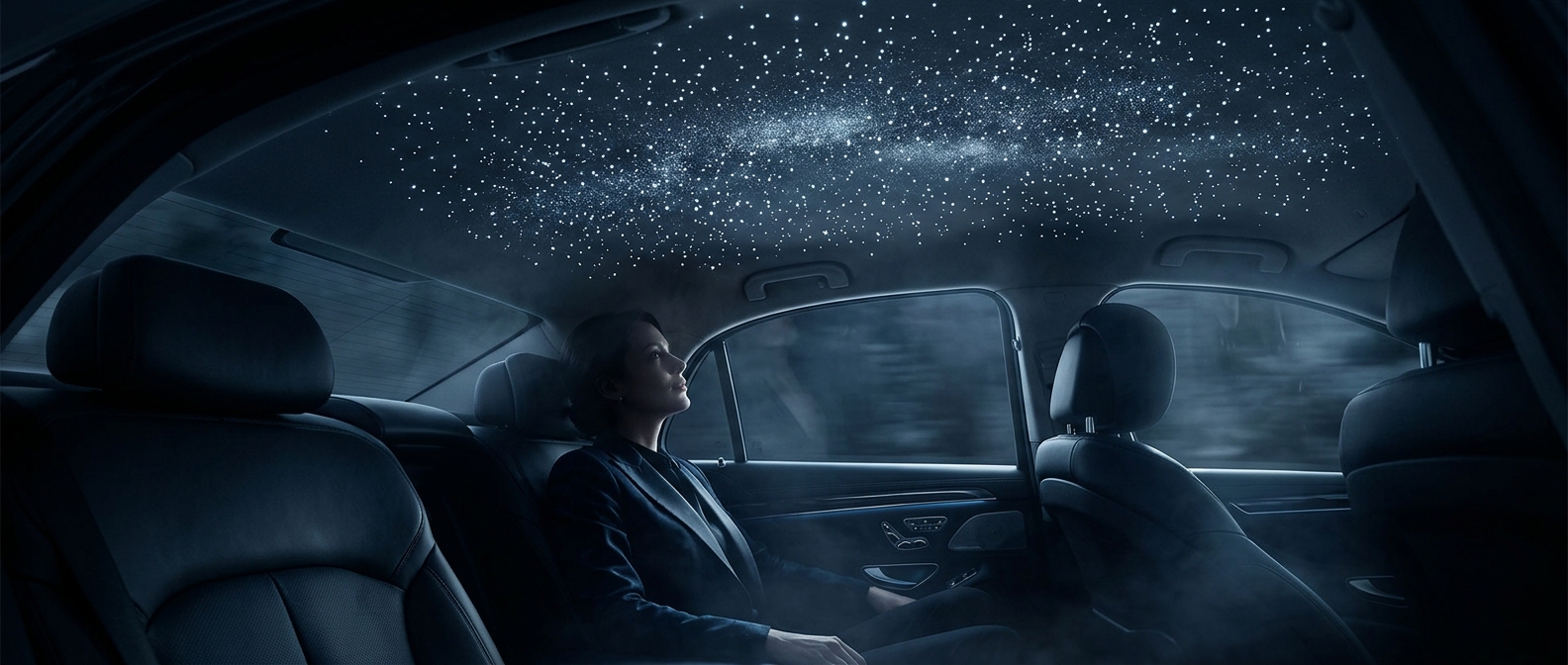
The effect begins not with dozens of lights in the roof, but with a light source tucked out of sight. In many versions, a compact illuminator sends light through bundles of very thin optical fibers—strands that guide light along their length. The fibers end at small points in the cabin’s headliner, the fabric-covered panel above the occupants, where each tip appears as a star.
Why Use Fibers Instead of Bulbs?
A fiber can carry light from a source hidden behind the trim to a tiny opening in the ceiling. That keeps the visible points small and avoids placing a separate lamp and electrical connection at every “star.” The illuminator may also change brightness or color, depending on the system, while the fiber ends remain fixed in the roof.
The tradeoff is that this is an intricate decorative finish, not a projection of a changing sky. The pattern is built into the headliner, so it cannot reproduce moving clouds or constellations unless the design adds separate effects. The fibers also have to be routed and secured before the ceiling panel is installed; once the trim is in place, access for repairs can be difficult.
A Night Sky That Travels With You
Because the points are part of the car’s interior, the display does not depend on darkness outside. A driver can sit beneath it in a tunnel, a garage, or a traffic jam, with the same fixed constellation overhead. The surprising part is how little of the system the eye sees: a hidden light source and fine strands turn an ordinary ceiling panel into a cabin-sized field of pinpricks.