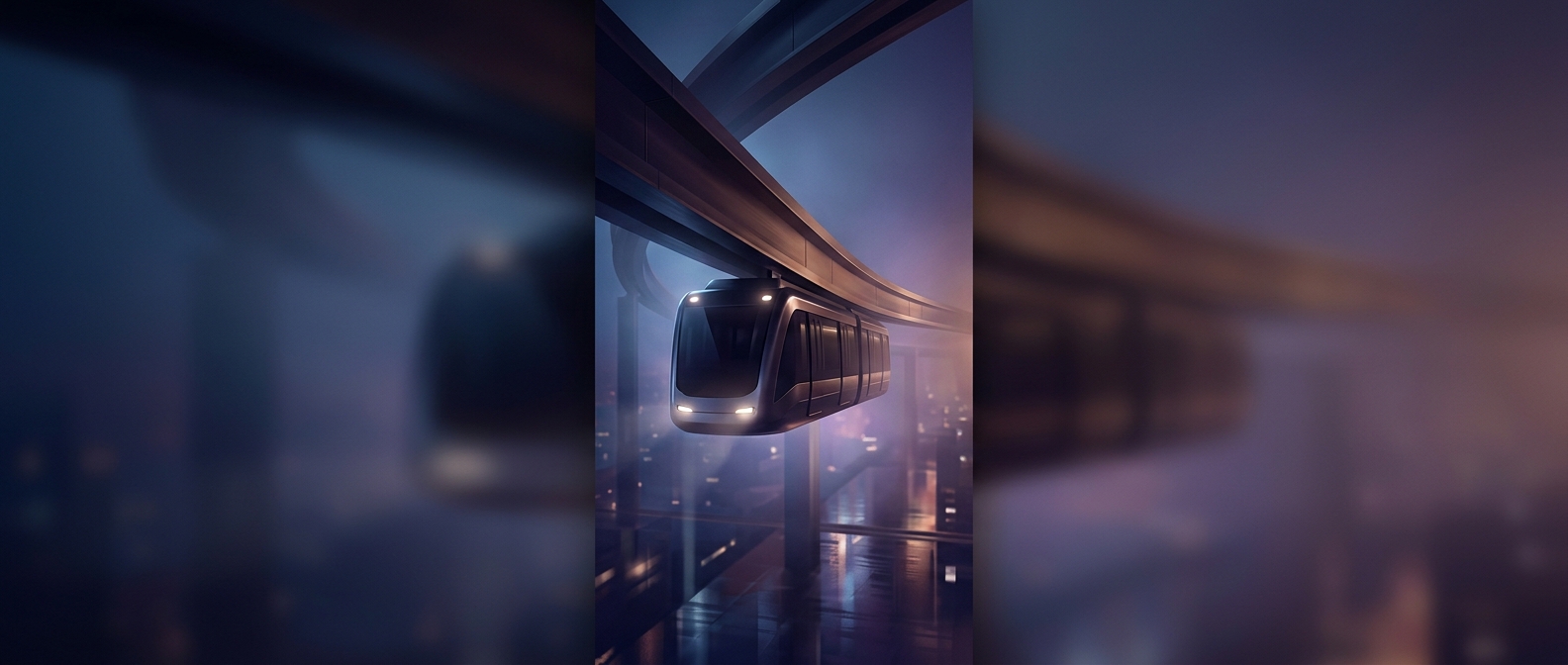
Why the cars hang below the beam
A suspended monorail carries its wheels and supporting frame inside or above a track beam, while the passenger car hangs from a short arm beneath it. The arrangement puts most of the train’s weight below the points where it meets the track. That low-hanging mass helps resist sideways tipping: if the car leans, gravity pulls its center of mass back toward the position directly under the beam.
This is a stabilizing effect, not a promise that the cabin never moves. Like a pendulum, a suspended car can swing, especially when the train accelerates, brakes, or rounds a curve. Its suspension and operating speed must keep that motion within acceptable limits.
What the layout changes
Because the track supports the train from above, the beam can be carried on columns without a conventional rail bed beneath the cars. That can be useful where ground space is limited or where a route needs to pass above streets and obstacles. Passengers also ride below the track rather than on top of it, so the vehicle’s shape and the way it enters and leaves stations differ from those of a conventional train.
The tradeoff is that the support system has to do more than hold the car’s weight. It must guide the train through curves and switches while keeping the suspended body clear of structures and managing its swing. Gravity helps keep the car beneath its track, but the beam, suspension, and operating controls make that balance usable in motion.