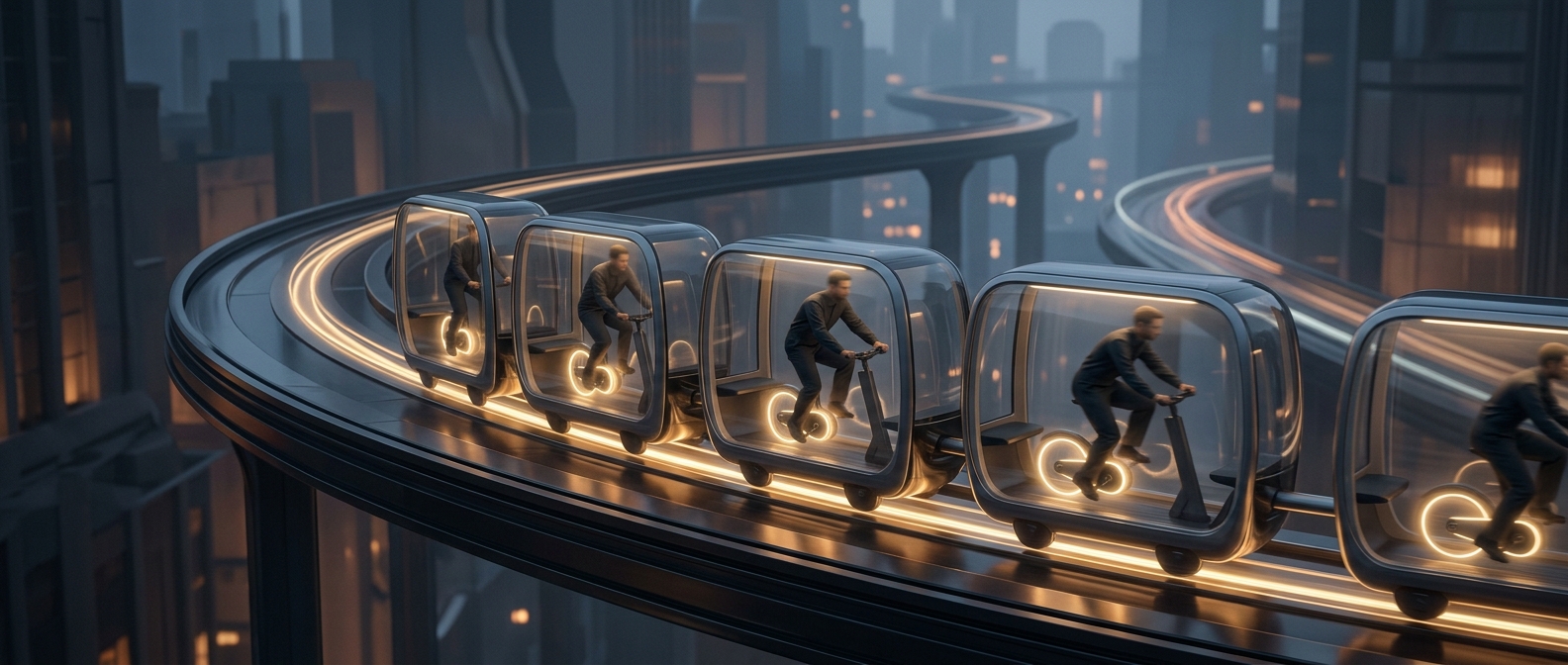
A bicycle that had to stay on its own track
The idea behind the 1892 New Jersey monorail was to turn a familiar human-powered machine into a form of guided transport. Instead of steering along an ordinary road, a rider pedaled a bicycle-like vehicle on a purpose-built wooden track. The track provided a fixed route between towns, while the passengers supplied the power: each trip depended on people pedaling rather than on an engine.
That arrangement changed the central problem of cycling. On a road, a bicycle can turn wherever the route allows; on a monorail, the vehicle is tied to the line’s construction. The track had to be built, maintained, and connected to useful destinations before the system could serve riders.
The route was the tradeoff
A dedicated track can guide traffic along a chosen corridor, but it also limits where a vehicle can go. An ordinary bicycle needs no special route: it can use existing streets and roads, and riders can choose among them. That flexibility helped make conventional bicycles more practical than a pedal-powered system whose usefulness depended on a separate wooden way.
The monorail’s challenge was therefore not simply whether people could pedal it. It was whether a purpose-built line could offer enough convenience to justify the infrastructure. The bicycle won on access: its route was already there.