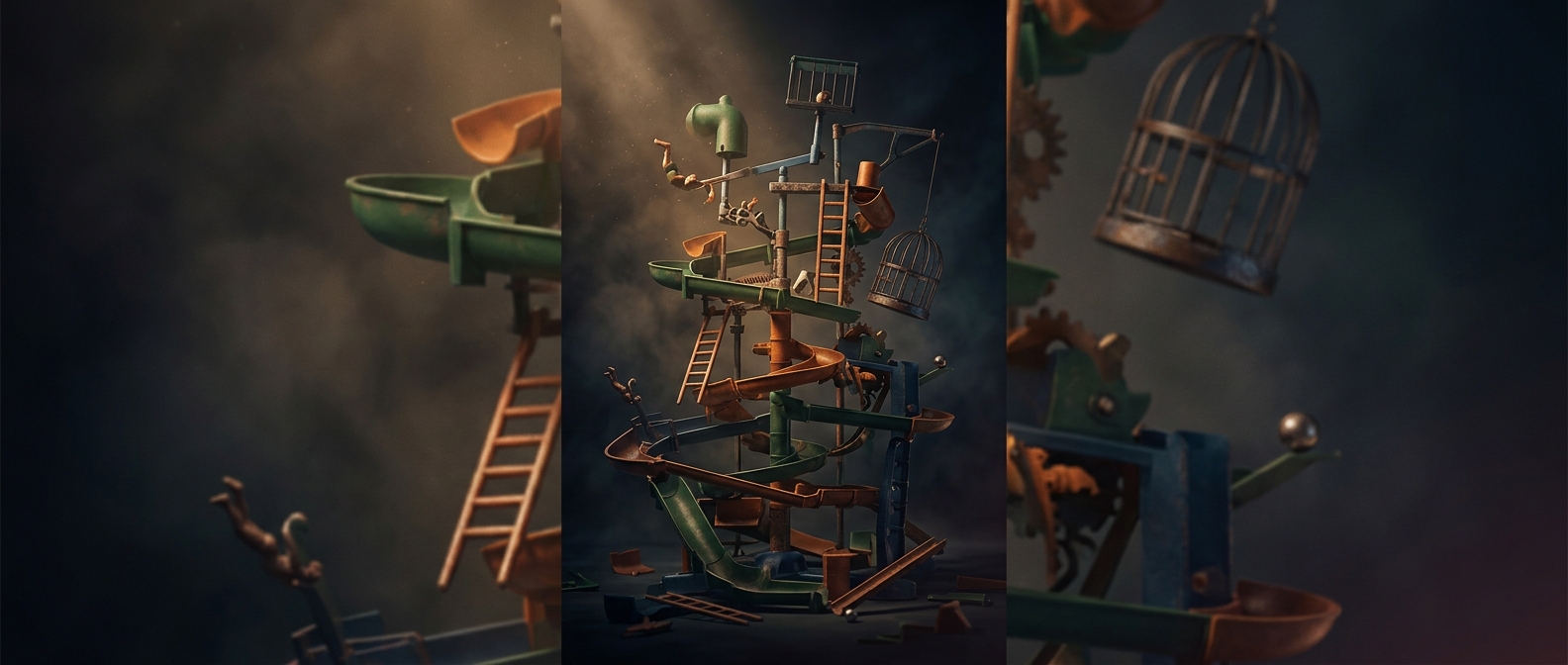
A Rube Goldberg machine on a game board
The appeal of Mouse Trap was its oversized chain reaction: players assembled a contraption meant to turn one small movement into a cascade of moving parts, ending with a cage dropping over a mouse. It borrowed the logic of a Rube Goldberg machine—a deliberately complicated way to accomplish a simple task—and made that complexity part of the game’s spectacle.
But a chain reaction is only as reliable as its weakest link. Each piece had to sit in the right place and move freely enough to trigger the next. If one part missed, stuck, or failed to transfer its motion, the sequence could stop before the cage fell. A working setup on a flat game board could become less predictable when played on an ordinary living-room surface, where bumps and small shifts were hard to avoid.
The spectacle came with a tradeoff
That fragility was built into the basic design challenge. A simple, robust trap might have worked more consistently, but it would not have delivered the same theatrical payoff. The contraption invited players to watch a cause-and-effect sequence unfold; its many moving parts also created many opportunities for it to go wrong.
So the game’s most memorable moment could be a near miss: the mouse escaped not because the trap lacked ambition, but because one tiny step in the elaborate sequence failed to do its job.