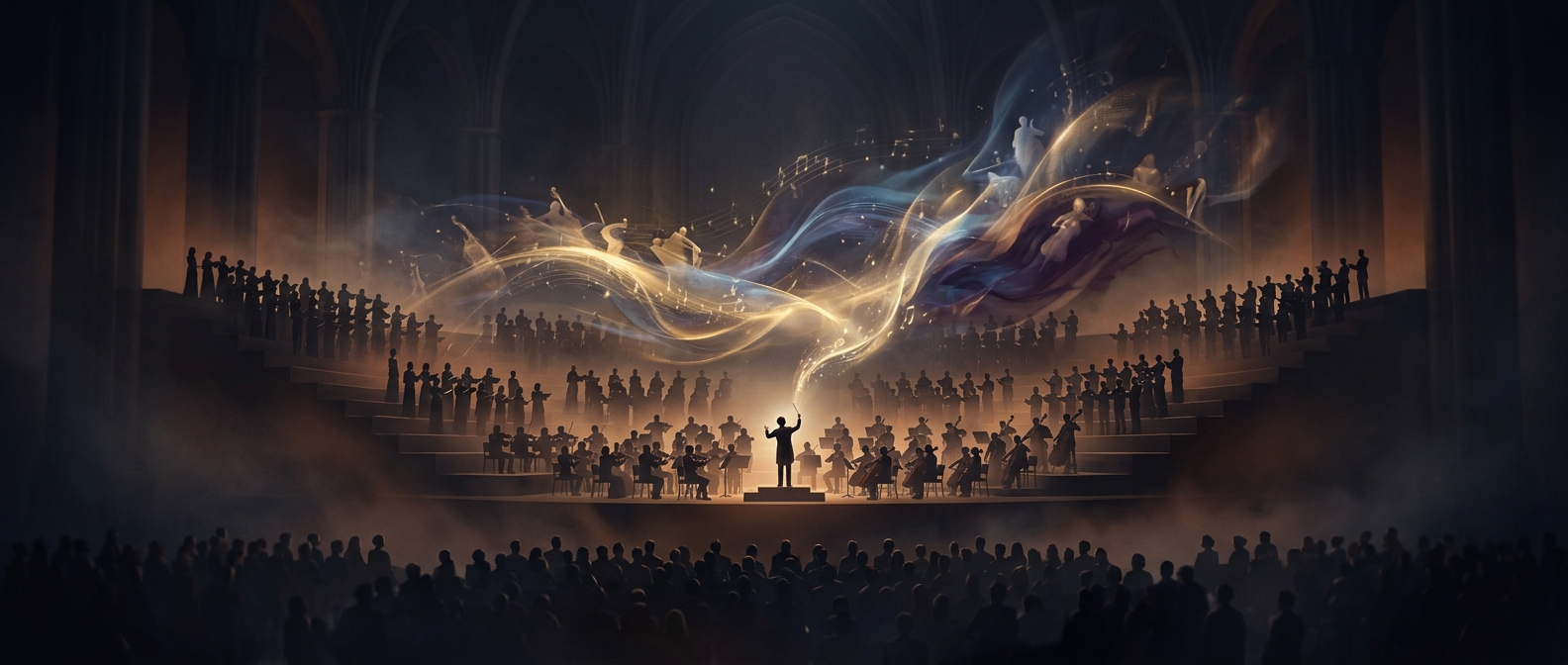
Why Mahler’s Eighth Became the “Symphony of a Thousand”
Gustav Mahler’s Eighth Symphony was conceived on a scale that made an ordinary orchestra feel insufficient. Its premiere, in Munich in 1910, brought together a large orchestra, multiple choirs, and vocal soloists. The nickname “Symphony of a Thousand” captured the spectacle: the performance required more than a thousand people, though the title was not Mahler’s own.
A symphony built around voices
The unusual size follows from the work’s design. Rather than treating the orchestra as the whole sound world, Mahler made human voices central throughout the piece. In its first part, a Latin hymn is sung by choirs and soloists; the second sets a scene from Goethe’s Faust, again combining voices with orchestra. The result moves between choral masses, individual singers, and instrumental passages, with the different forces answering and reinforcing one another.
That structure demanded more than simply adding extra players. The performers had to coordinate across a large ensemble, where singers and instrumentalists could be physically spread out and sound takes time to travel. A conductor had to hold the pulse together so that distant groups could enter as one and the music’s surges would feel deliberate rather than chaotic.
Scale as part of the effect
The huge cast is not just a logistical curiosity: it shapes what listeners hear. Massed voices can turn a musical phrase into a public, collective declaration, while soloists give the vast sound a human focus. Mahler’s challenge was to make those contrasting forces belong to one continuous musical argument.
The premiere’s scale made the nickname memorable, but the deeper ambition was musical: to use the combined power of orchestra and chorus as a single instrument. The “thousand” mattered because every performer had to contribute to that shared sound.