The Shallow Fold in Each Face
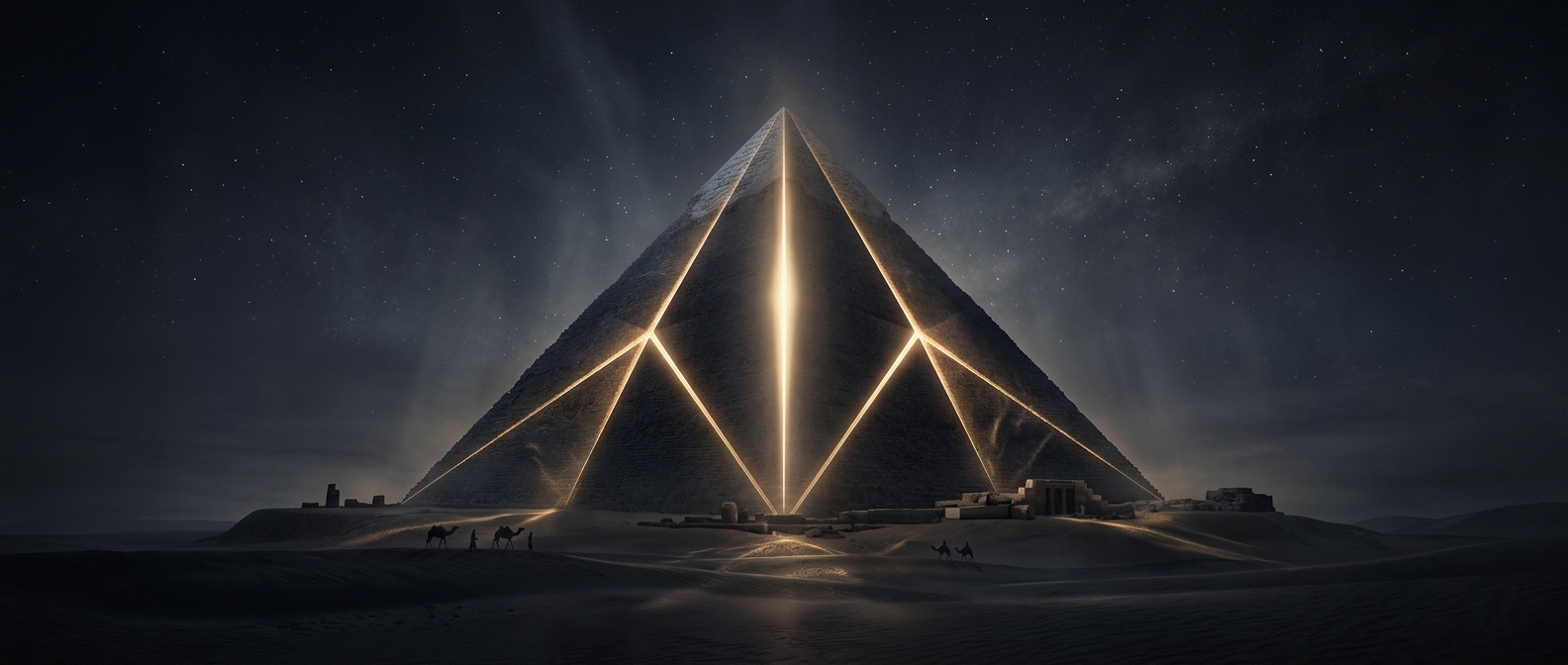
The Great Pyramid still has four sides at its base and four triangular faces. But those faces are not perfectly flat: each dips inward slightly along a line running from the peak toward the middle of its base. The curve is subtle enough to disappear from ordinary ground-level views, which is why the monument usually looks like the familiar four-sided pyramid.
In the right light, the indentation changes how sunlight falls across the stone. One half of a face can catch the light differently from the other, making the central fold visible and the face appear divided. The effect briefly gives the pyramid an eight-sided outline—not because it has eight actual faces, but because each of its four faces reads as two planes.
What the Shape Does—and Doesn’t—Tell Us
The fold is a feature of the pyramid’s surface, not its footprint: viewed from above, the base remains square. Nor does the visible effect by itself explain why the builders made the faces this way. The precise construction process and the reason for the concavity are not settled by the shape alone, so it would be a mistake to treat the optical effect as proof of a particular design intention.
That distinction is what makes the detail so striking. The pyramid’s celebrated geometry seems simple from a distance, yet a small change in the angle of its outer faces can transform what the eye sees. For a moment, shifting light makes one of the world’s most recognizable monuments look as though it has twice as many sides.