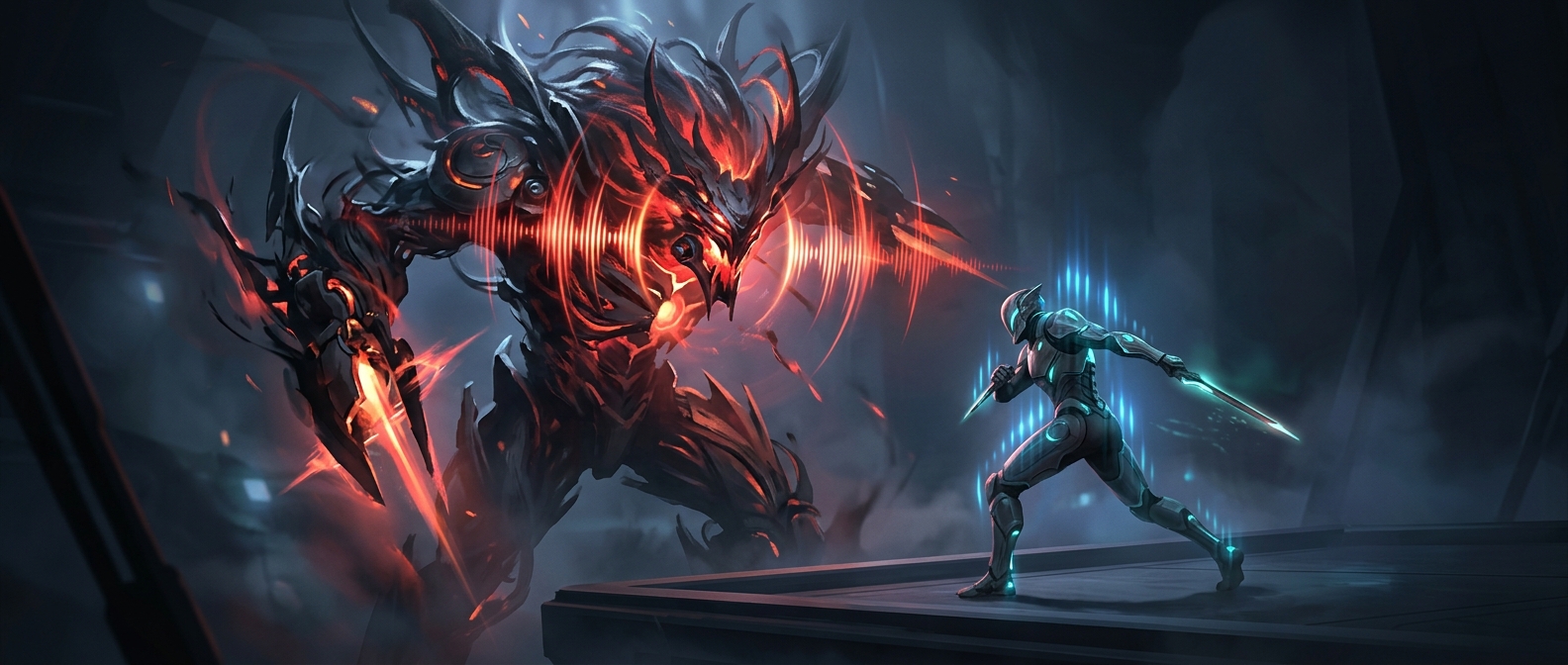
How Uneven Beats Keep a Boss Fight Off Balance
In much game music, beats arrive in familiar groups—often four, with a strong accent returning at regular intervals. The listener quickly learns where the musical “floor” is. A composer can unsettle that expectation by using an asymmetrical time signature, a meter whose beats do not divide into the usual even-feeling pattern.
A bar of 7/8, for example, contains seven eighth-note pulses. But composers rarely treat all seven alike: they might group them as 2+2+3, then emphasize those groups with different accents. The result is not random noise. It is a repeating pattern that is coherent enough to follow but awkward to predict by instinct. Just as the listener starts anticipating the next downbeat, the grouping can make it arrive sooner—or later—than expected.
Unease Without Musical Chaos
That tension suits a boss encounter because the player is already watching for attacks, openings, and changes in the enemy’s behavior. A lopsided rhythmic pattern adds another layer of instability: the music resists settling into the same steady groove that often supports ordinary exploration. Repeated accents can also make the boss seem to lurch, feint, or press forward, even when the underlying tempo stays constant.
The effect depends on how the meter is written, not simply on an unusual number at the start of the score. A seven-beat bar can feel almost smooth if its accents are arranged predictably; a more familiar meter can feel tense if the accents shift. Composers choose the grouping, tempo, instrumentation, and repetition together, balancing agitation against playability. The music needs to unsettle the player without becoming so hard to parse that it obscures the action.
That balance is the point: the rhythm can make the fight feel precarious while still giving the player a pattern to hear. The beat keeps moving—but it never quite lands where the body expects.