How Forced Perspective Makes a Street Feel Taller
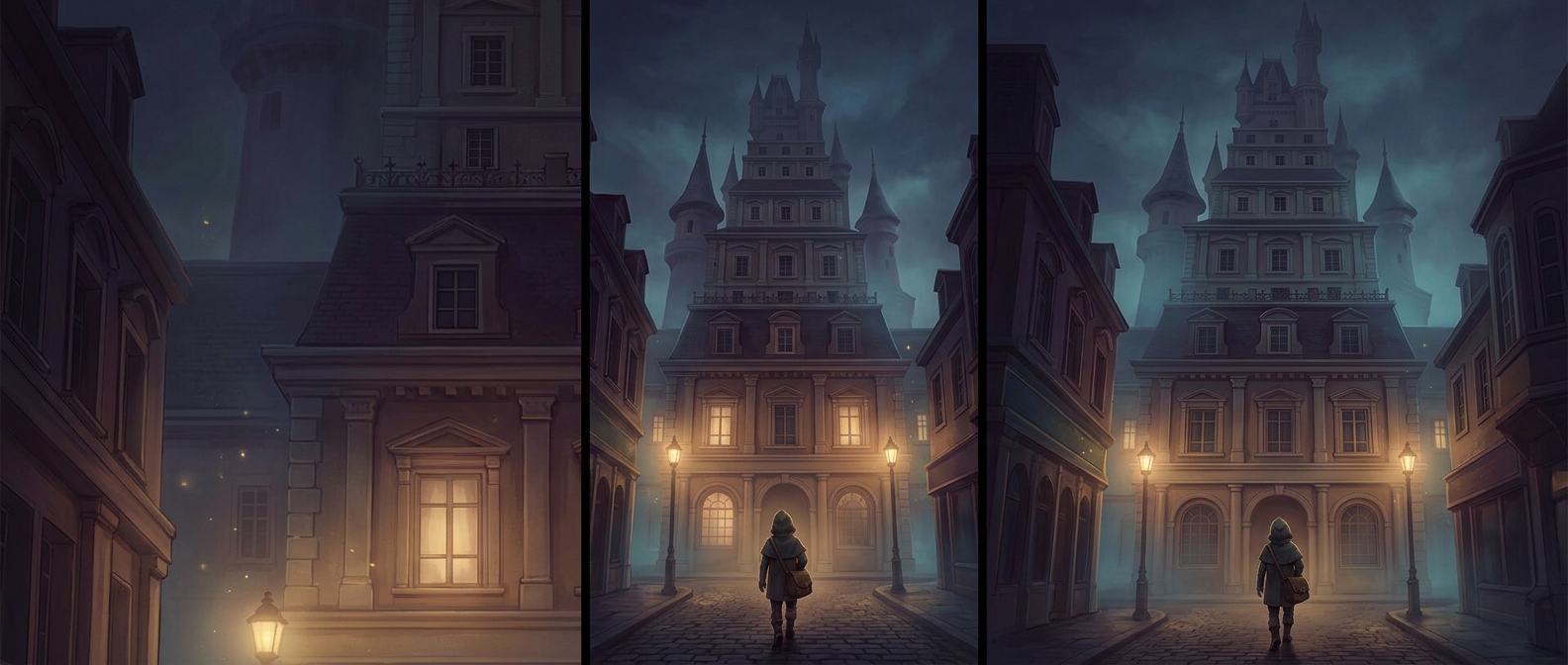
A building on a theme-park street may be much shorter than its storybook appearance suggests. Designers create that impression with forced perspective: they make visual cues shrink with height, so the eye reads the facade as receding farther away—and therefore as larger overall.
The Details That Fool the Eye
Bricks, windows, and other features on upper levels are built or painted smaller than matching details below. The change can be gradual: each higher section uses slightly reduced elements, rather than an abrupt switch that would look like a trick. Rooflines and decorative trim may also be scaled to continue the effect.
The eye uses familiar objects as a rough ruler. When a window appears smaller, we usually infer that it is farther away. On a carefully designed facade, the shrinking details encourage that interpretation even though the building is one continuous structure. From the intended viewpoint, its upper portion seems to extend into the distance, making the whole building seem taller.
A Trick With a Specific Viewpoint
Forced perspective works best from the street or walkway the designers expect visitors to use. Seen from another angle—or from a nearby elevated position—the mismatched sizes may become easier to notice. That constraint is part of the design: the facade is an illusion tuned to the visitor’s ordinary line of sight, not a miniature building meant to look convincing from every direction.
The practical payoff is a tall, dramatic streetscape without requiring every building to reach its apparent height. A visitor can look up at a towering upper story while the smaller architectural details quietly tell the eye that it must be farther away.