A hydraulic machine for tracing economic feedback
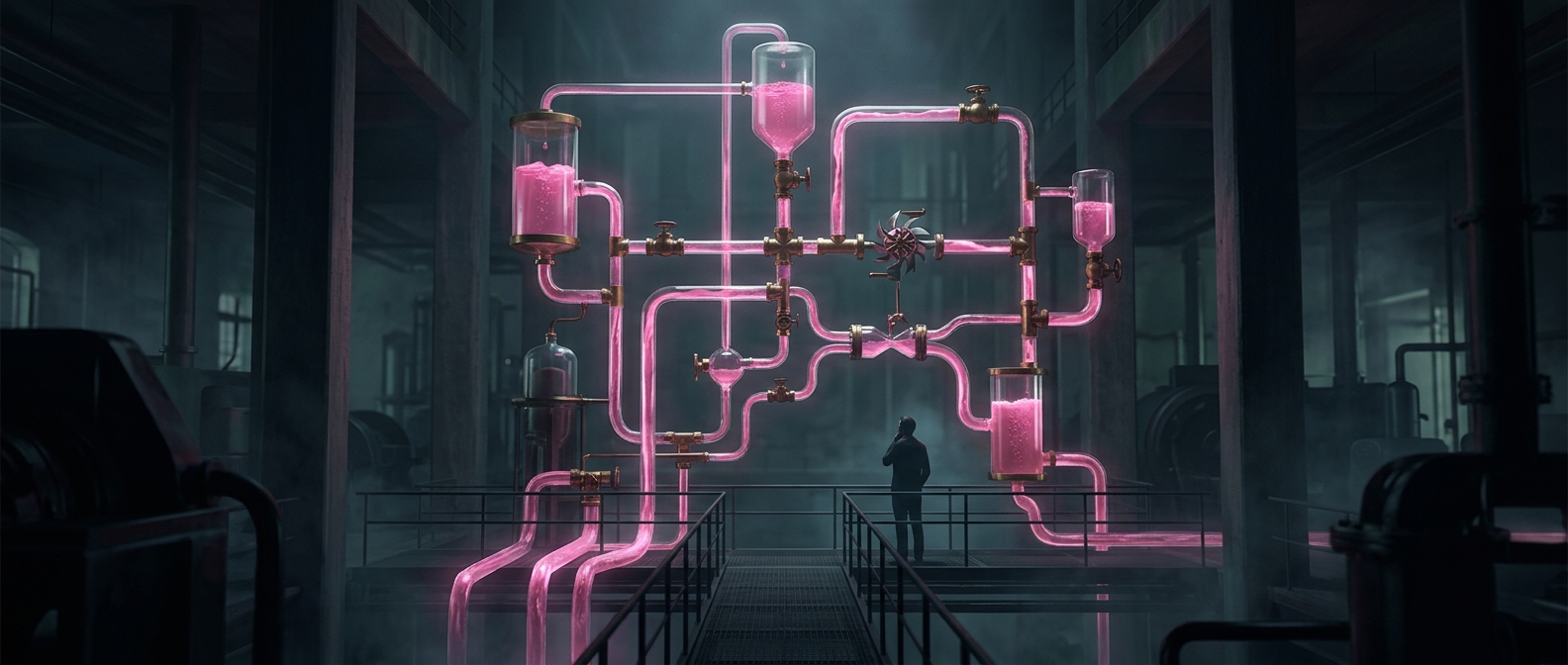
The MONIAC made a central difficulty in economics visible: one change can ripple through many parts of an economy before its effects settle. Built by economist and engineer Bill Phillips in 1949, it represented the flow of money with moving water. Its tanks stood for parts of the economy, while pipes and adjustable valves represented transactions and the rates at which money moved between them.
The crucial idea was feedback. A policy change—such as adjusting taxes—could alter how much money flowed onward into spending, saving, or investment. Those shifts affected other flows, which could in turn change the levels in the tanks. Because water takes time to travel and accumulate, the machine could show not just where a change might lead, but how its effects unfolded over time.
Why watching the water mattered
An equation can describe how one economic variable affects another, but a network of equations is harder to grasp at a glance. In the MONIAC, opening or narrowing a valve changed the system physically. A tank rising or draining made the consequences of the adjustment legible, including effects that might not be immediate or confined to one part of the model.
That made the machine a teaching and demonstration tool, not a miniature country or an oracle. Its behavior depended on the economic relationships built into its pipes and controls; it could illustrate those assumptions, not prove that they captured every real-world complication. Its enduring appeal lies in that unusual translation: an abstract argument about policy became a visible sequence of water moving, backing up, and spilling into the next part of the system.