A military tool built around a tight set of constraints
The wartime Jeep was designed to carry people and equipment where ordinary cars could not go, but it also had to be light enough for military transport and straightforward to maintain far from a repair shop. Its compact body and short wheelbase helped it maneuver over broken ground; four-wheel drive sent engine power to both axles when one set of wheels struggled for traction.
That arrangement depended on more than ruggedness. The vehicle had to be useful to many units and maintainable by mechanics working under difficult conditions. Ford and Willys produced versions to a shared military design, making parts and repairs more practical across a huge fleet. The result was a machine whose value came partly from doing many jobs adequately, rather than one job exceptionally.
What changed when the war ended
Civilian buyers wanted that mobility for farms, construction sites, and other work beyond paved roads. Willys adapted the military vehicle into the CJ, or “Civilian Jeep,” line, adding features suited to regular use while retaining its basic shape and four-wheel-drive layout. The transition was not simply a matter of repainting surplus equipment: a civilian vehicle had to make sense as something people could buy, use, and maintain outside a military organization.
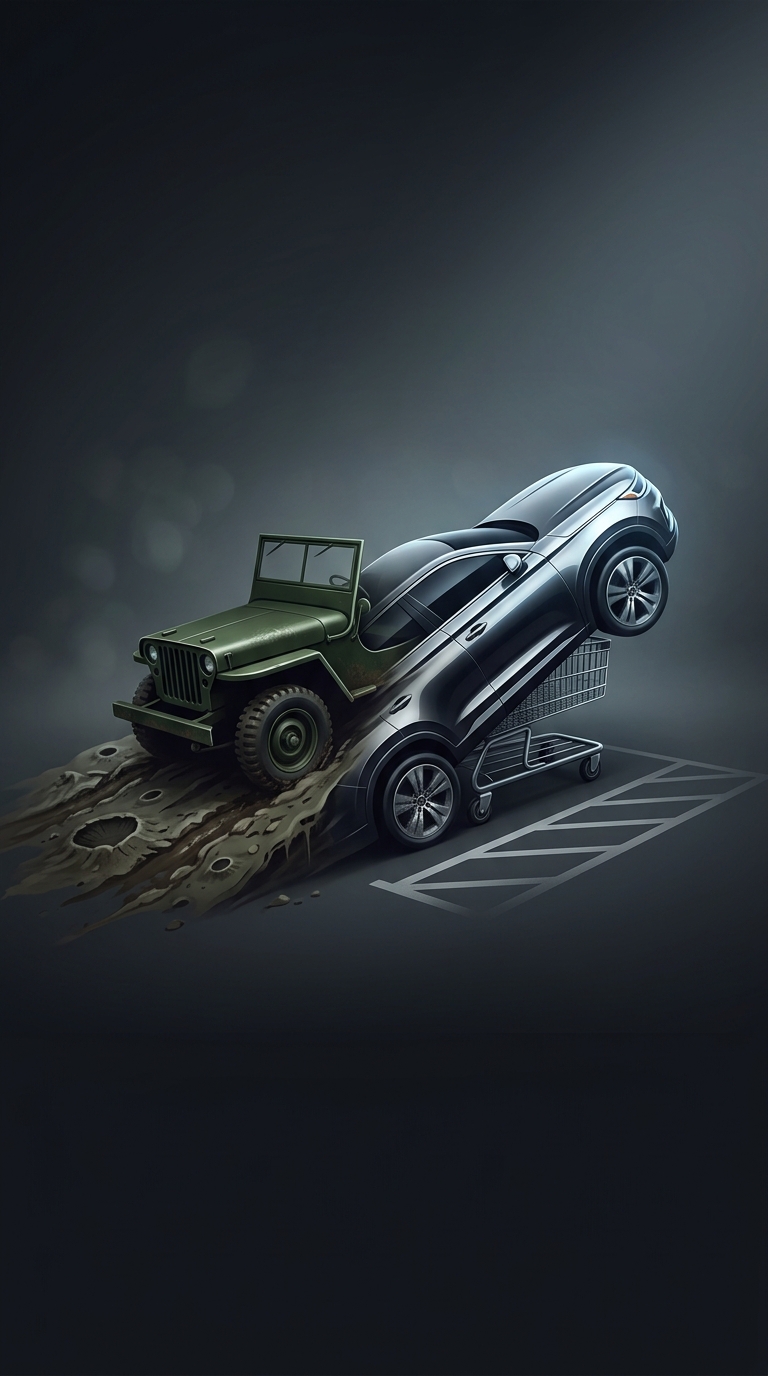
That legacy explains the Jeep’s lasting appeal—and the tension in its modern image. A short, upright body and hardware meant for difficult terrain still signal capability, even when most trips are on smooth roads. The original design solved a practical problem: getting people and gear through places that stopped ordinary vehicles. Its descendants can sell that promise even when the hardest obstacle on the day’s route is a crowded parking lot.