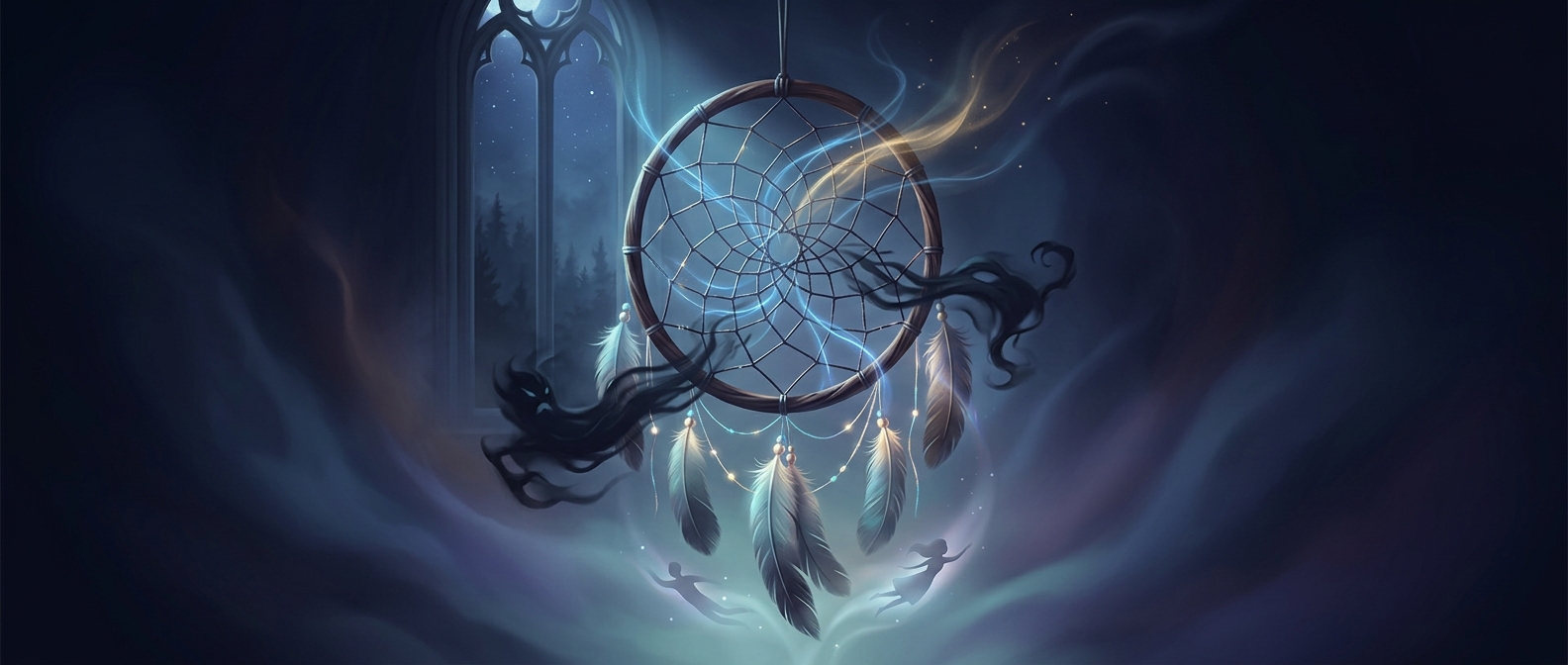
A protective symbol with a particular history
The dreamcatcher is most closely associated with the Ojibwe, also known as Anishinaabe, people. Its familiar form—a hoop woven with a web and often decorated with feathers or beads—carries a teaching about protection during sleep. In some tellings, harmful dreams are caught in the web, while good dreams pass through the opening and reach the sleeper. The details and meanings can differ among families and communities; it is not a single, fixed rule shared by everyone.
The web makes the teaching visible
The design turns an invisible fear into something that can be pictured: troubling dreams meet a barrier, while a clear path remains open for comforting ones. Feathers are often understood as helping good dreams travel gently down to the sleeping child. Traditionally, dreamcatchers were associated with children’s sleeping spaces, making the object a tangible expression of care as well as a symbol of spiritual protection.
From community practice to popular decoration
Dreamcatchers became widely known beyond Ojibwe communities, and their designs and meanings have shifted as they spread. Today, many are sold as decorations or souvenirs, sometimes detached from the traditions that give them significance. Remembering that context adds meaning to the familiar shape: it is not merely a web on a hoop, but a cultural object built around the hope that a child can sleep safely.
And the web has an ordinary job, too: like any small woven surface, it can collect dust, so a cherished dreamcatcher may need gentle cleaning.