How Cairo’s Unmarked Roads Organize Traffic
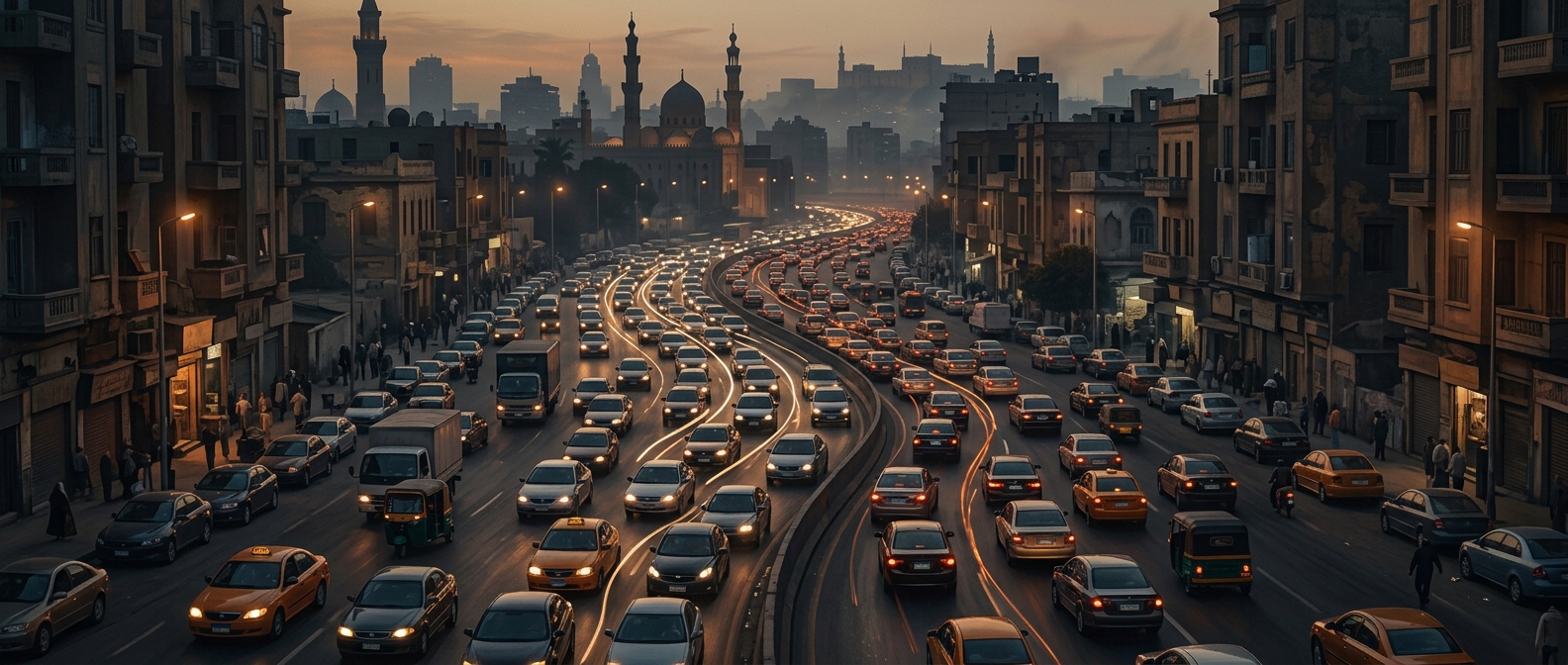
Where lane lines are absent or hard to see, drivers cannot rely on paint to tell them where one stream of traffic ends and another begins. Instead, they judge the usable space around them—watching nearby vehicles, adjusting their position, and moving into gaps as they open. A car may travel beside another without occupying a clearly defined lane, so the road’s width is shared more flexibly than a painted layout would suggest.
Reading the Flow, Not Just the Road
That flexibility makes traffic feel less like a set of separate queues and more like a continuous flow. Drivers have to pay close attention to the vehicles immediately around them, because a small change in speed or position can affect who can move next. Horns and visible gestures can help communicate intentions, but they do not replace the constant visual negotiation.
The arrangement is not simply a matter of ignoring traffic rules: signs, signals, intersections, and other road users still shape what drivers can do. Nor does every Cairo street look the same. The key difference is that, where lane markings are missing, faded, or not followed, drivers must infer their path from the traffic itself.
The Tradeoff of a Flexible Road
Using more of the available width can let vehicles fit through space that fixed lanes might leave unused. But it also makes movement harder to predict, especially for visitors accustomed to cars staying within painted boundaries. On an unmarked stretch, the most useful guide is often not an imagined lane line but the direction and speed of the surrounding flow.